
April 10, 1927
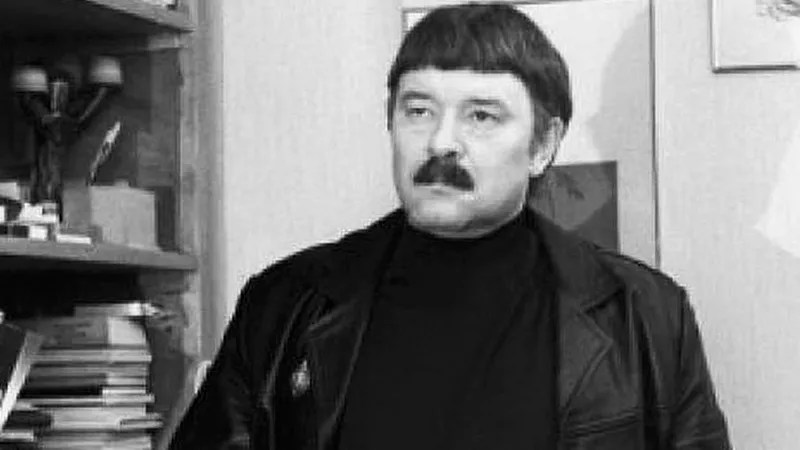
В Chita was born Vil Lipatov — writer, journalist, screenwriter. Master of "industrial" prose. Author of the story about the local police officer Aniskina.
Phrases about the people most often cover up indifference to the people
His father was a journalist, his mother a teacher. His son was named after Lenin. He grew up in Novosibirsk и Tomsk region. In fifth grade, he began writing poetry and became fascinated with cinema—movies were often shown in his village. This later influenced his prose: he called it a "diluted film script."
In 1944, he entered the Novosibirsk Institute of Military Engineers, but was expelled after two years. In 1947, he graduated from the Faculty of Physics and Mathematics. Kolpashevsky State Teachers' Institute near Tomsk. He got a job as a rural teacher.
In 1952, he graduated from the history department of Tomsk State Pedagogical Institute as an external student. He worked for local television and newspapers, publishing essays, short stories, feuilletons, and reviews.
In 1958, he returned to his native Chita, where he wrote for the local newspaper and magazine Novy Mir. He was a staff correspondent for Sovetskaya Rossiya.
In 1967, at 40, he moved to Moscow He worked at Pravda, Izvestia, and Literaturnaya Gazeta, and taught at the Gorky Literary Institute.
It is a pity that in recent years the Russian language has been growing poorer and fading – the hard, official word clanks in it like iron, the foreign syllable gurgles, the compound words, seemingly Russian, but foreign to the ear, are twisted into a tangled interweaving – grain procurement, agricultural department, stacker-rolling unit
In his heroes – rivermen and fishermen, drivers and rural workers, workers and engineers – he subtly ridiculed conformism.
In the late 60s, he wrote a parody parable, "Elections of the Fiftieth," about a journalist preparing a story about an elderly worker living in a flooded basement and continuing to praise Stalin. It was never published.
He achieved nationwide fame in 1968 with the film adaptation of the novella "The Village Detective," about a rural police officer named Aniskina. A film trilogy was made based on it: the eponymous "The Village Detective" and its sequels, "Aniskina and Fantomas" and "And Again Aniskina."
You've been working as a policeman in the village since you were young, but there are no enemies of the people in the village.
They had no idea about real beauty.
In total, 12 films were made based on his scripts.
In the 1970s, the novels “And It’s All About Him” (about the problems of the Komsomol movement in the USSR) and “Igor Savvovich” (about the tragedy of thirty-year-olds during the era of stagnation) were published.
In 1971 he published the story “Even Before the War” about the life and customs of a Siberian village.
There is no secret about deposits in the village
I wanted to work, like I wanted to die.
His latest work, A Lion on the Lawn, is an autobiographical novel-confession about the dizzying career of a conformist newspaperman in the post-Stalinist era.
How was it before? Every monarch considered it a privilege to quote a writer. And now they quote Brezhnev.
He died in Moscow in 1979, at the age of 52. According to the official version, from a blood clot.