
"I was surprised by how popular it was." A blogger from Krasnodar moved to Istanbul and started leading walks for Russian speakers.

Bashkir Dinar Burangulov developed an interest in mosaics while still in Krasnodar and led city tours that attracted dozens of people. After moving to Istanbul, Dinar explored the city better than most Turks, started a blog, and began receiving hundreds of messages asking for tours of unusual places. Dinar spoke with a correspondent from "Govorit NeMoskva" about life as an immigrant in Turkey, Turkish art, and, most importantly, who needs such tours in the first place.
— Dinar, tell us when you started blogging and when it became popular?
I'm originally from Bashkortostan. I grew up and studied there. But in 2018, I moved to Krasnodar for work. I started walking around the city a lot, exploring the surrounding area. On weekends, I traveled to southern Russia and the North Caucasus. I've always been interested in history, and monumental art emerged during a rather interesting historical period. I believe that mosaics, in this regard, best reflect current events and the overall history and culture of a country. I started photographing mosaics and other interesting places and posting them on Instagram. I didn't want to turn my personal page into a blog, so in March 2020, I created another account, "Kizil Paşa" (Red Pasha). I chose the name in honor of the nickname of the first Soviet diplomat to the Arab world, Karim Khakimov, a fellow Bashkortostan resident of mine. I didn't just post photos of mosaics; I sought out all the available information, conducted some research, and pored over archives. And soon I began creating guidebooks to various places united by a common theme. And then people started asking me more and more often if they could go for a walk with me, if I could lead a tour. That's how the blog accumulated about 16 subscribers.

When I moved to Turkey, I discovered that there were mosaics there too. So I started another account, Kizil.Istanbul, where I started sharing stories about different places in Istanbul.
— How did it happen that you moved and why to Turkey?
My love for Turkey began in childhood. In the 1990s, my grandparents quit their jobs, and my grandfather began transporting various goods from Moscow, while my grandmother began transporting goods from Turkey. She first went to Turkey with a friend in 1996, and from then on, she became what was called a shuttle trader. That's why all my toys and clothes were from Turkey. I remember postcards of Istanbul's mosques and palaces—they captured my childhood imagination. Then my mother also began shopping in Turkey.
I started reading a lot about the Ottoman Empire, Turkish history, and Islam. In 2010, I started attending a Muslim madrasah (a Muslim religious, educational, and secondary school institution [after primary education – Ed.]) to pray. From the madrasah, we were sent to a camp at the Russian-Islamic University, and the students from this university were sent to Turkey for internships, and I also heard many enthusiastic reviews about Turkey from them. As a result, by the age of 14 or 15, I had formed a picture of a magical land somewhere, where Islam, ancient temples, a language similar to ours, Bashkir, existed—an oriental fairytale. And I was fired up with the idea of going there. In 2014, I visited Turkey for the first time. To say that I liked it is an understatement. And even then, I decided that one day I would live here.
When the time came, I enrolled in the law department at Bashkir State University, but on the very first day after admission, I transferred to International Relations, intending to one day go to Turkey through that program. While I was studying, from 2014 to 2018, I completed all my student internships at Turkish Airlines, at their Ufa branch. In the summer of 2017, my mother sent me to a month-long summer school in Turkey. Within two weeks, I was speaking broken Turkish, even though I barely knew my native Bashkir, which is similar to Turkish. A month later, I had conversational Turkish.

A few months later, my mother moved to Turkey. And since 2018, I've been splitting my time between cities: I'd visit my mother and then head back to Russia. After an internship at Turkish Airlines, I started working at the Turkish low-cost airline Atlas Global. The airline was doing poorly, with frequent plane breakdowns, and eventually closed down. But I worked there for four months, improving my English and learning professional Turkish. After that, I went back to Turkish Airlines and got a permanent position. I wanted to work in Ufa, but they really needed someone in Krasnodar. That's how I ended up in the south. My plan was simple: move to Turkey through Turkish Airlines. But in 2020, the coronavirus pandemic hit, and I was laid off.
— Why didn’t you go to visit your mother in Turkey?
By this time, I'd gotten so used to Krasnodar that I wanted to explore it and the surrounding area more. When I received my compensation from Turkish Airlines, I went traveling around the North Caucasus—all the places I couldn't get to because of work. Then I went through a slightly strange period at work. First, I got a job at a company that sold vegetables to large supermarket chains. I worked in various cities, but I was always looking for work related to Turkey and the Turkish language. And eventually, I got a job in Novorossiysk with a Syrian Kurd. I thought I'd need to establish connections with suppliers from Turkey, but I ended up working as a simple storekeeper. It wasn't the experience I wanted, but during that time, I got to explore the city.
After that, I returned to Krasnodar and continued my job search, speaking English and Turkish. I ended up getting a job at the Hilton, working a 2/2 schedule. On my two free days, I strolled around the city, looking for interesting places and describing them on my blog. I started collaborating with local public groups, posting my photos there.
People started bombarding me with questions about whether they could go on walks with me, how to find all the places I write about. That's when I decided to try giving city tours, and it was a hit. Huge crowds showed up, and I basically had to work two days at the Hilton and spend the other two days off on my own tours. I realized I was working seven days a week, sleeping only three to four hours, and I couldn't last. I also realized that tours weren't a one-time thing; people were interested. Ultimately, I quit the Hilton and, in 2021, I started working for myself, earning money giving city tours.
— When did you move to Turkey?
— In the fall of 2022, if we're talking about permanent residence. My love for Turkey hasn't faded. After moving, I discovered that there are mosaics here too. I became interested in Turkish mosaics, and since December 2021, I've been fully dedicated to their study. During this time, I've met a huge number of artists and discovered a huge number of works that can be used to study the history of Turkish art from the mid-1960s.
— Where did you get such a good knowledge of history?
At university, even though we were majoring in International Relations, we only had five different history courses in our first year: World History, Russian History, History of International Relations, History of Law, and "The Middle East in Light of World Civilization." Then, history courses were divided by country: the history of China, the history of Great Britain, and so on, then the history of international economics, and the history of the Russian economy. We even joked that we were studying at the history department. In theory, we were supposed to be training diplomats, but we became more historians and political scientists with a knowledge of foreign languages.
— Where does this interest in monumentalism and monumental artists come from?
I study art more as a historian. My artistic background, frankly, is a bit lacking, although I'm catching up now by reading a lot. In Krasnodar, while photographing and studying mosaics, I realized I was building a whole journal. I was curious about who made these mosaics. For example, in Armavir, all the mosaics were made by the artist Anatoly Gordeyev—an artist from Kazakhstan who moved to Kuban.


A Soviet mosaic on the facade of a residential building near the Children's Library in Armavir
I started looking for biographies. It's difficult in Russia: not a single mosaic is signed. It seems like it used to be thought that they weren't the work of a single artist, but rather a "collective effort." And mosaics are often in poor condition, rarely restored, and, unfortunately, there's a general feeling that no one cares about them. But many of the artists are still alive, or their children and grandchildren are. So I began meeting with the artists themselves and their descendants.
— How do you find them?
— It varies. For example, once in Krasnodar, I was on a tour of the ancient Vsesvyatskoye Cemetery in the city center, and a girl came up to me and said she knew the artist who made the wooden bas-reliefs in the "U Maxima" cafe, Nikolai Turkov. She gave me his contact information, but I didn't even realize who I was calling. It turned out that this man had headed the Krasnodar Union of Artists during the Soviet era—meaning, even if he didn't make all the mosaics, he was the one who approved them all. Many of his works were destroyed, and he told me that in the past, mosaicists didn't sign their works; they simply didn't attach any importance to it.


Illustration of the bas-relief in the cafe "U Maxima" (photo from the Facebook group "Tupodar")
Through Turkov, I began connecting with other mosaic artists in Krasnodar: Igor Demidenko, Svetlan Demkina, and Levon Tamanyan. The latter's story unfolded as well: I saw his mosaic, Googled his name, and stumbled upon an article about him in a local newspaper. I went there, asked for his contact information, called him, and two hours later, we were meeting. I met with all these artists to learn more about their lives and work, as well as what other works they had created, and I recorded interviews with them. Now I've amassed such a collection that I intend to compile it all into a book.
— You said that mosaics are a reflection of history. In this regard, can you compare Russia and Turkey?
"The first thing that struck me about the mosaics in Istanbul was that they were all inscribed: they all had the artist's name and the year they were created. And each one had a plaque with the title of the work and a short description. The Turks have a lot to be proud of: unlike us, they value their artists, restore, and protect almost all the works. Individualism was more developed here. And most importantly, Turkish historians are eager to research all the information. It's just that I can't find it in Russian; it's all in Turkish, but there are articles, and all I have to do is translate them and cross-check them against several sources."
In Russia, to study the work of a mosaic artist, you have to go to the archives. For example, in Krasnodar, I met the son of the artist Belomytsev, who gave me his mother's phone number, and she provided me with the archives. And now I'm sorting through them.


Soviet mosaics in Krasnodar
In this regard, things are a bit simpler with Turkish artists. But I hope that, in part through my work, I'll provide the Russian-speaking world with an opportunity to become acquainted with them. Incidentally, I recently gave a lecture in Russian about these artists in Istanbul. About 100 people attended. I was actually surprised by how popular it was, and how interested Russian-speaking people are in monumental art in Turkey.
— Why do you think that is? After all, this is a rather specific topic.
On the one hand, a lot of Russians have moved here now. Most of them are seasoned tourists; they've seen a lot in their own countries and traveled a lot. On the other hand, many of the guides and tours offered in Istanbul are outdated. They always show the same old things. When I started blogging about Istanbul, many people started asking me to share places, to walk with me, and to share information. And I like doing here what I did in Russia.
Walking among mosaics and, so to speak, monumental art is one of my most popular walks. A wide variety of people come: art historians, concert organizers, concert venue staff, eco-recycling organizers. Of course, there are also sophisticated people. The main sights, like Hagia Sophia and the Galata Tower, can be explored independently. And there's plenty of information about them: just open the internet and look. Mosaics, however, are not an obvious thing. Many are surprised that they exist not only in Russia but also in Turkey.
— Are there any specific differences between these mosaics?
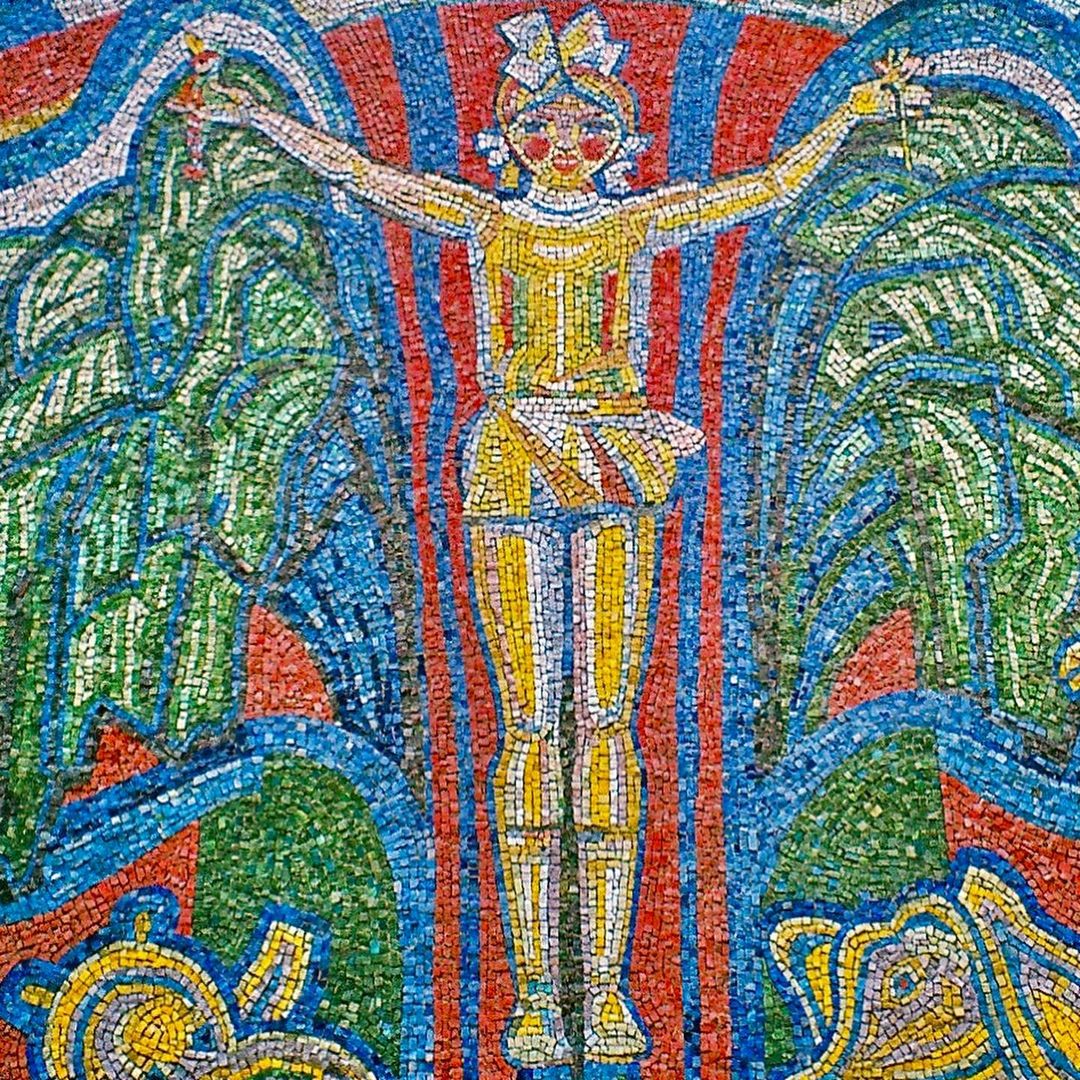
Both Turkish and Soviet mosaics made in the 1960s draw on Byzantine influences. They are a continuation of Byzantine techniques, but each culture interpreted them in its own unique way. Thus, Soviet mosaics are characterized by their own mythology: each mosaic from the 1960s depicts one or more stages in the construction of the Soviet state: sailors, the cruiser Aurora, the Great October Revolution, the battleship Potemkin, Red Army soldiers in Budyonnovka hats, then the Civil War, industrialization, factories, then the construction of socialism, various scenes on the theme of universal equality, schools, the Pioneers, Komsomol members, workers at their machines, and then the conquest of space, the launch of the first rocket, Yuri Gagarin and the exploration of outer space.


Mosaics in the underground passages of Rostov-on-Don
Soviet mosaics, in essence, reflect the history of socialism. I suspect the same logic applies here as in churches. There, images of various biblical scenes on the walls helped illiterate people, unable to read, recognize the Bible and its most important passages. Similarly, mosaics were intended to tell the story of the rise of the USSR and socialism and to shape political views. I can also draw another comparison with church canon. As far as I know, the first mosaics were created by artists who painted icons in churches, and they transferred certain images and a certain style to Soviet mosaics. For example, the image of the Motherland in mosaics is visually similar to the image of the Virgin Mary. Thus, Soviet mosaics continue the Byzantine tradition on the one hand, and on the other, they inherit the tradition of Slavic icon painting.
Turkish mosaics are different. Firstly, they follow Islamic tradition, and in Islam, creating images of living beings is forbidden. There are different concepts, but if you adhere to tradition, it's forbidden. Simply put, it's because you're trying on the role of God, and when the Great Day of Judgment arrives, all the images you created but didn't breathe soul into will gather and ask you why you couldn't give them life.
You'll answer that you're not God to bring things to life. And then it will be as if you've deceived them. And they'll take away all your good deeds. The second reason is this: when people decided to erect a monument to the Prophet, who called people to pray to God, they initially remembered what kind of monument it was, but over time, its true meaning began to fade from their memory, and they decided that the Prophet was God, and then that the image was God, and they began to pray not to God, but to the drawing. That's why the Prophet Muhammad forbade the drawing of living beings, lest it lead to fetishism. And since Islam prohibited the depiction of living beings, Islamic art began to develop in other areas: geometry, abstraction, landscape painting, ornamentation, and calligraphy. Incidentally, in Bashkortostan, living beings weren't painted until the 20th century. Turkish artists also, despite the fact that they lived and worked in the Turkish Republic, a secular state, adhered to these canons in their work.


There are also differences in technique: Soviet artists made mosaics from smalt (colored opaque glass — Ed.), and most Turkish works are made of ceramics. Interestingly, many Turkish artists were Marxists. While the Soviet intelligentsia looked West, the Western intelligentsia looked East.
— How do you find these mosaics?
Sometimes it's by chance, while walking the streets, sometimes I go there on purpose, having read about the works, sometimes I pick up on things from Turkish art historians and architectural bloggers. Sometimes I stumble across old photos of works online, search for the location, and go there. That's how I met leading Turkish mosaic artists Bedri Rahmi and Ercument Kalmık, and a leading ceramicist who was also interested in ceramics, Furya Koral.
— Do Russian speakers who have moved to Turkey sometimes complain that they lack cultural life, that Turks are, in some sense, culturally lagging behind? What do you think about this?
"Perhaps they are lagging behind in some areas, but more likely they are simply following a different path. After the collapse of the USSR, we began to experience strong European influence, and it still does. But Turkey has its own culture, its own way. It hosts a huge number of exhibitions, concerts by world-class stars, all kinds of shows, and film festivals. For those who have moved here, Russian-language public groups have now emerged that cover some of these events, but they regurgitate first-hand information. In fact, there's much more here than is covered there. It's a dead end for those who don't speak Turkish. Because of this, many events and the whole scene are overlooked. But that doesn't mean it doesn't exist. Istanbul is definitely a great place." (Life is in full swing - translated from Turkish).