
Memory is locked away: in Borovsk, artist Vladimir Ovchinnikov was banned from opening a private museum of political repression.

In Borovsk, Kaluga Region, an 85-year-old artist Vladimir Ovchinnikov Invited over 100 like-minded people to the opening of the Museum of Political Repression. The exhibition was scheduled to welcome its first visitors on October 29, the eve of Remembrance Day for the Victims of Political Repression. But the opening never took place. And whether it will even take place is difficult to say today.
Vladimir Ovchinnikov, a mural painter fined twice for "discrediting the army," told NeMoskva that the museum exhibition he spent three months working on will be locked away until better times in the country. This decision was made by the owner of the "Prison Castle" tourist complex, who had previously invited him to paint the walls of the art installation and later allocated three rooms for the future museum. Specifically, these are solitary confinement cells: the complex is built on the site of a real 19th-century prison.
A private museum of political repression could be established in a massive two-story "ostrog" prison that existed until the 30s, after which solitary confinement cells were used as housing for top-performing workers, earning the prison the nickname "Shock Worker's House." After the shock workers were relocated in 2015, the prison was repeatedly set on fire by homeless people. Several years ago, entrepreneur Svetlana Shorokhova privatized the dilapidated building and built a tourist complex there, complete with a restaurant, a cinema, and exhibits depicting prison life and medieval torture instruments.
At the artist's request, Svetlana Shorokhova allocated three solitary confinement cells for the museum of repressions. But on the eve of the planned opening, she changed her mind. A week before the opening, she informed Ovchinnikov that she would "lock" the door on October 29 if the muralist decided to go against her wishes.
"The museum was created without my knowledge, that's the first thing, and secondly, it's my wish; I'm the owner of this property," she commented on her position to NeMoskva.
– Will this museum interfere with the Prison Castle in any way?
"The documents are being legalized, and I don't need any extra problems right now. I don't know how people will react when the property is being formalized. Moreover, they misnamed it—it's an art object, not a proper museum. If it's a museum, it's meant to be accessible to people with disabilities. And since it's a cultural heritage site, we technically can't install ramps. The castle has ancient staircases, and any renovation must follow a legally approved design."
– And if the documents for the site are approved, are you ready to open a museum, albeit under a different name?
– When it passes, then the “if” will surface.
– Vladimir Ovchinnikov didn’t say that he wants to open a museum?
"He won't open what he wants on my property. You're going to let someone open whatever they want in their home, but they'll have to agree to it with you, right? What do you think of that? It wasn't agreed upon with me."
– When he asked you for three cameras, did he say what he would do in them?
"He was just starting to draw his pictures. But I haven't seen the full concept yet. So what kind of discovery are we talking about?"
– Didn’t anyone put pressure on you and say: “Svetlana Petrovna, close the Museum of Political Repressions”?
"No one pressured me at all; this is my personal decision. As the owner of this property. Vladimir Alexandrovich and I discussed everything and developed a plan of action. He has no choice but to agree with me."
On October 26, Shorokhova reiterated to Ovchinnikov that, for technical reasons and due to the museum's content, the entire complex could simply be closed: "You have politics there, and my facility could be closed completely." So, it's now difficult to know whether Ovchinnikov will ever reopen the museum. Meanwhile, NeMoskva will report on what visitors to the museum might have seen on October 29, had it opened.

Vladimir Ovchinnikov painted the walls—one series, "Scenes from the History of the Prison," consisting of 13 compositions, and the diptych, "A Time to Cast Away Stones and a Time to Gather Stones." He also created the room of the noblewoman Morozova, exiled to Borovsk.

"It was a relatively small space, cramped, but still, something could have been done there," Ovchinnikov, whose frescoes people travel to Borovsk from all over Russia to see, and whose memorials to the victims of political repression in Borovsk were mercilessly destroyed by the authorities, tells NeMoskva.
“I have long been trying to get the authorities to perpetuate the memory of the victims of repression, I tried to get an exhibition set up in the local history museum, but to no avail.
And now the people of Borovsk could have a whole museum, which the artist worked on all summer and autumn.
“I worked on the museum for three months, and prepared for it for 20 years,” says Borovsk’s most famous living resident.
The central feature of the exhibition is a memorial to the victims of the repressions of the Borovsk district, entitled "From the Abyss of Oblivion. Political Terror in the Borovsk District."

"These are portraits painted from prison photographs on the wall. There are 80 faces in total. There are QR codes that allow one to access complete information about the victim—archival biographical information, family composition, occupation, property ownership, previous repressions, when and for what arrest, witnesses' statements, and the victim's own statements—all from copies of criminal cases I obtained. I also recorded the recollections of descendants," Vladimir Alexandrovich explains about the main focus of the exhibition.
The first solitary cell contains 21 portraits, the second 37, and the third 22. A total of 80 portraits of real people whose lives were ground up by the Soviet meat grinder. In the first hall, you can use a QR code to find out the names of all those executed by the executioners and those who never returned from the camps. There are over 300 names. Next to them are the numbers of those killed in the war—230 conscripted by the Borovsk military enlistment office.
Visitors can use the stories of those repressed to understand the scale of the extermination of "enemies of the people" in Russia using just one district as an example. For this purpose, Vladimir Ovchinnikov, the custodian of historical memory, created a map, "Geography of Terror," featuring the Borovsk District and its settlements. Each settlement is listed with the number of residents repressed by period and direction: for example, the peasant uprising against the Soviets, dispossession, and the disenfranchisement. Many settlements have already disappeared, but remain listed. The statistics table includes not only the numbers of terror victims but also those rehabilitated up to the present day.

According to the 1939 census, 40 people lived in the Borovsk district. Of these, one in four—or 10—were caught up in the repressions before the Great Patriotic War. Vladimir Ovchinnikov, a Muscovite who moved to Borovsk after retiring, became interested in their fates. Of the 10 victims, almost 60% have been rehabilitated because the amateur historian, while still allowed access, spent weeks in the archives studying the files.

Ovchinnikov achieved the rehabilitation of 1159 Borovsk residents who had been deprived of their voting rights, the rehabilitation of 205 participants in the 1918 peasant uprising, 12 people convicted in 1922 for resisting the confiscation of church valuables from the Pafnutyev-Borovsky Monastery, and 15 kulaks and Soviet employees.

In the museum, the artist specifically showed the destruction of people based on class affiliation – the mural “Eminent Citizens of Borovsk” is based on the famous poem by the bard Igor Kokhanovsky “The Law of Dialectics.”
First they beat the most noble, Then they shot the hardest workers, Then the ranks of the senselessly killed grew from thousands of the most vocal.
.................................................. .....
The state, weakened by torture, did not yet know about the losses of those who were, did not know that the NUMBER of those killed would respond to it with the QUALITY of those living.
On one of the walls there are 15 faces – a group portrait of priests, merchants, intellectuals, the mayor and other prominent citizens of Borovsk, killed by the Soviet government.
"Those Killed for Christ. Requiem" is another exhibit in the unopened museum. The painting depicts 14 executed and imprisoned Borovsk clergy. Visitors here could carefully read the lines of another exhibit—a 1937 Borovsk newspaper, "For the Commune," with front-page headlines like "Great and Terrible is the Wrath of the People" and "Shoot Every Last One."
Opposite the 1937 newspaper, the museum's creator hung two articles from the contemporary Borovsk district newspaper, "Borovskie Izvestia," which are similar in style and techniques to the 1937 press.
In the third "chamber-hall," the mural is dedicated to the erasure of memory—what happened during the decades of Soviet power and continues to happen today.

"I've never told anyone about the museum before. Why? The authorities are against commemorating it; they're against any events related to memory, which they want to completely erase. Since 2012, there have been constant refusals—to publish analyses and recollections in the newspaper, to organize an exhibition, a memorial—everything has been denied. The only thing they've done is bring a boulder from Solovki and erect it in memory of the victims of political repression."


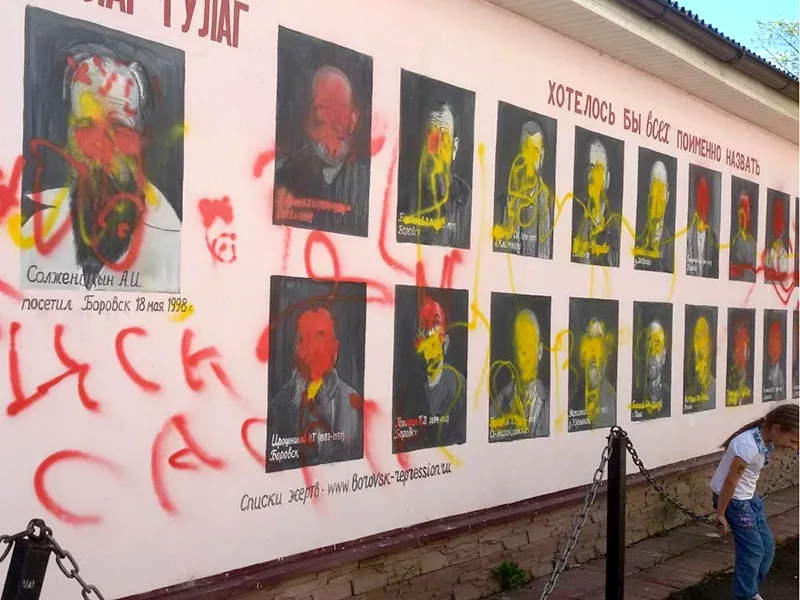
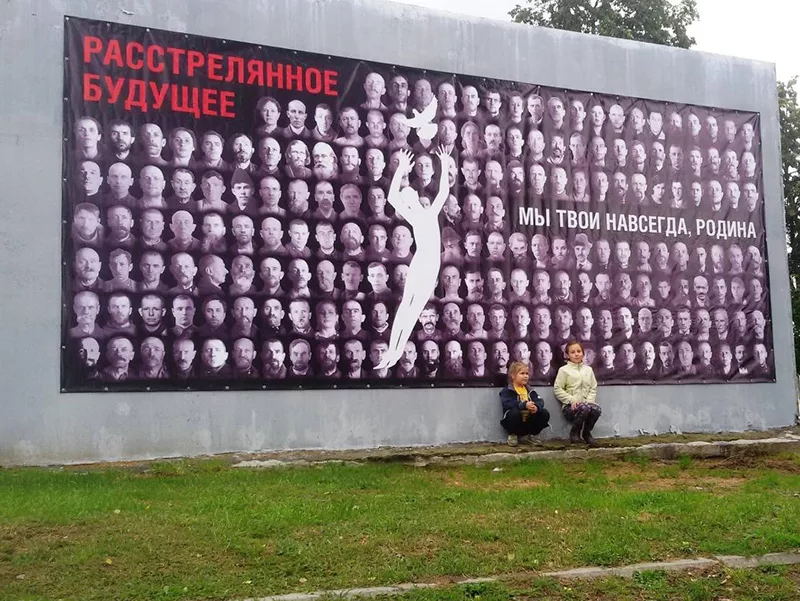


In Borovsk, authorities destroyed five memorials to victims of political repression, created by Vladimir Ovchinnikov. Now, even before it had opened, the museum itself is under threat of closure.
The situation with the private museum of political repression in Borovsk currently seems at a standstill. Perhaps something will change when Svetlana Shorokhova completes the paperwork for the former prison. But from talking with her, it's clear that the political context of Ovchinnikov's works worries her. And her concerns are understandable. These are the times. The history of terror in the Borovsk district has been sealed.


