
A plane on a mane: After an emergency landing in a wheat field, residents of Moskovka who had never flown before now have their own Airbus behind their vegetable gardens.

On September 12, the small village of Moskovka in the Ubinsky District of the Novosibirsk Region made headlines. At 9:44 a.m. local time, an Airbus A320 landed in a wheat field near the village.
A Ural Airlines flight from Sochi to Omsk made an emergency landing. There were 161 people on board, including 23 children, and six crew members. The aircraft commander was 33-year-old Sergei Belov, the co-pilot was 56-year-old Eduard Semyonov, the senior flight attendant was 34-year-old Daria Glushkova, and the flight attendants were 22-year-old Aysha Gummetova, 31-year-old Dmitry Kostylev, and 27-year-old Dmitry Ryadov.

While approaching Omsk, the pilot-in-command reported a malfunction with the green hydraulics (when the green hydraulics fail, the spoilers, which are part of the braking system, and the flaps malfunction). A longer runway was needed to land the plane. The Airbus crew decided to divert to Tolmachevo Airport in Novosibirsk. Strong winds, a low flight level of 5500 meters, and the landing gear doors deployed and unable to be retracted increased fuel consumption by 25%, as reported by Sergey Skuratov, owner and CEO of Ural Airlines, on the day of the incident. According to Skuratov, when the decision was made to fly to Novosibirsk, the fuel load was 4200 kg, while the estimated fuel requirement was 3800 kg.
They were unable to reach Tolmachev. To avoid tragedy, the captain landed the plane in a wheat field in the Ubinsky District, between the villages of Kamenka and Moskovka, 190 km from Tolmachev. None of the passengers or crew were injured.
Rosaviatsiya and experts are seeking answers to the following questions: "Was the runway length in Omsk calculated correctly? Did the captain consider that fuel consumption would increase by 25% if the aircraft flew 595 km from Omsk?"
Alone claimthat the pilots miscalculated the fuel, and that more than 5000 kg was required to implement the landing plan in Novosibirsk, calling this a wild and banal error in calculations.
According to another version, the pilots did not notice in time that they were flying with the landing gear down. information Mash, the Rosaviatsia report after decoding the black boxes indicated that Captain Sergei Belov and co-pilot Eduard Semyonov failed to check the indicators that indicated they were flying with the landing gear down, which also increased fuel consumption.
Rosaviatsiya is conducting an investigation. The pilots have been temporarily grounded.
A NeMoskva journalist traveled to the Ubinsky District of Novosibirsk Oblast to see a mothballed Airbus A320 and talk to local residents about how the plane has changed their daily lives.
The drive from Novosibirsk to the village of Ubinskoye takes just over three hours, assuming no traffic. Before the plane, they decided to stop at the community center, where the passengers and crew had been brought after landing. On a Sunday morning in October, the village of five thousand is deserted. A pensioner is taking a smartphone photo of a stele with the names of those who died in the Great Patriotic War. They started chatting: she didn't go there, she didn't see it.
"They sent me some photos. It was a plane, yes, but it landed in the wrong place. It would have been better if there had been a different reason for our area's fame. It's good there were no casualties. It was lucky the plane landed on a high surface of land, what we call a griva (mane) there. It's a large mound, about a kilometer wide, nature created this elevation, and Komarovsky's field was there. The plane landed right in his wheat." — says Lyudmila Kuts, who previously worked in the local village council, where she accompanied me in a businesslike manner.

There is no one in the administration except for two employees of the unified dispatch service on duty.
“We haven’t been there,” they both grin, saying they still haven’t reached the main attraction of the area this fall, and explain how to get there.
"When you get to Moskovka, there's a grain threshing floor on the right, and beyond that, a huge field. Just turn past the grain threshing floor and go straight ahead. The road there is already paved. There's security there now, and a metal fence. It's a private security company."

While Lyudmila Aleksandrovna is escorting me to the fire station, I run into Nikolai Terentyev, the deputy head of the Ubinsky district, who was at the scene of the plane's landing almost immediately.
— How did the signal about the upcoming landing arrive?
"The chief was informed about it initially. He moved to the site. The task force and I followed suit when we figured out where he was going. There was basically nowhere else to go, just this mane. Then the evacuation work began, placing people in a temporary holding facility."
Local authorities managed to quickly organize buses, the Ministry of Emergency Situations, and ambulances from their own, Ubinsky, and Kargatsky districts.

Terentyev says no one saw the plane land. He says rumor has it that someone noticed it plummeting.
"It's located quite a distance from a populated area. If it were in the immediate vicinity, it would be possible to photograph and see it, and there are forests there, not a deserted place."
When Ubinsk rescuers rushed to the landing site, the passengers were already a distance away, in the forest. They feared the plane might explode.
— You said you needed psychological help? How quickly did you find psychologists?
"We have two psychologists here. One from the school, the other from the social welfare center. People were in shock. Everyone reacted differently. Some, on the contrary, were celebrating, you could say, their second birthday. Some were worried. Two or three people actually needed medical attention. There were asthma attacks, blood pressure issues, and one passenger had a bruised leg. But other than that, you know, they needed to talk. People needed to talk.
— There were more than 20 children on the plane. How did they react?
"The kids are fine. When the kids arrived here at the community center, they didn't cry; everything was calm. No tears, no screaming."
— Did you take pictures?
— And when was there time to take photos? Everyone was running around solving current issues. There was no time for photos!
— Did the government thank you?
"For us, the most important gratitude is the gratitude of the passengers. They left and said thank you, and that's the most important thing. And yes, it was discussed at the governor's office. Both Deputy Governor Sergei Nikolaevich Semka and Kostylevskiy (Minister of Transport and Roads of the Novosibirsk Region Government – ed.) were there. As for how well we did our job, let our superiors judge."
Nikolai Terentyev doesn't yet know exactly how the Airbus will be transported to Yekaterinburg.
"They're currently considering various options. Both takeoff and dismantling. I don't have any reliable information yet about how this will work," he says.
Seven or eight people are waiting at the local fire station, waiting for the call. They, too, are still wondering how the vessel will leave the "parking lot." The firefighters were the first to reach the ridge. The distance from Ubinskoye to Moskovka is 7 km; the drive took 10 minutes.

Nikolai was in the second crew, which arrived after the first. He says the passengers, having fled the plane, behaved surprisingly calmly, but fear and nervousness were clearly visible on their faces.
"The flight attendants and pilots did everything quickly. Four emergency slides were installed, and the windows were knocked out. We were glad we were alive."
Firefighters were removed from the scene late in the evening. When the first photos emerged, a black fire scar appeared above the wing, but it later became clear that it was simply mud that had accumulated as the plane skidded to a stop on the ground. Everyone at the fire station flatly refused to be photographed, as did many other locals. And they themselves did not approach the plane or passengers with cameras during the incident.
"I felt awkward. Everyone there was in a commotion, in fear, and I was supposed to take photos?!
"It'll be taking off soon!" the firefighters laugh. "The repairmen are there, making repairs."
"Well, that's just rumor. We don't know what happens next."
"There are two specialists there. They're running, cleaning, and checking the engines," says Nikolai.
— Do you think it will take off secretly?
"Well, it probably won't work secretly. They'll send all the special equipment there. We'll probably be there."
— Do you now consider the plane a Ubinsk landmark?
"No. What kind of landmark is that?! Everything turned out okay, everyone's alive and well, that's all," says the tall, blond Nikolai, certain that few people remember the incident anymore.
On the way to the cultural center, where Ural Airlines passengers had been waiting for over three hours, I met a mother and daughter leaving the church. Tatyana Krashchuk worked her entire life as a proofreader for the local newspaper, Ubinsky Vestnik. She is currently in mourning – her husband has died. She learned of the happy landing from the news ticker on TV.

“The main thing is that the people were saved. And that place between Moskovka and Kamenka is called the Griva. My husband and I always went there to pick mushrooms. The soil there is higher than other areas. You can go down to Moskovka without pedaling. It’s not just salty soil there; if it had been salty soil, they would have drowned. Salt licks, especially after rain, are very sticky. And in the field there is sandy soil. Clay with sand,” Tatyana Adamovna says quietly. “In general, it seems like people weren’t surprised. They don’t even talk about the plane anymore. Visitors come up to me and ask how to get to Moskovka; I want to see the plane. But for people to talk about it, to admire it… well, it’s an emergency and that’s all for us. Ubinka has become famous – a plane landed in our field! But the place where it landed is beautiful.”

At the Community Center, the attendant and a sound engineer who'd dropped by showed them the halls where people had been brought from the plane. Tea and sandwiches were served. Mostly, everyone waited calmly, but some, after the shock, were given "injections and drops."
We have a capacity of 300 people. The children were all calm. One person said, "Mom, I also want to fly on a plane," and she replied, "No, it's better to walk!"
They say that someone left sunglasses and a toy on the plane, according to the head of the district, Oleg Konyuk. posted about finds on VKontakte - "maybe it's worth something to someone."
— What did people say when they left?
"They thanked them. The crew arrived later. They were questioned or interrogated here. The passengers thanked them," emphasizes sound engineer Vasily Ivanov.
"Maybe they were upset at home later. They said goodbye. Come and visit us again! No, they say, it's better if you come to us."
— It's funny now, but it wasn't funny back then.
— Has there ever been an emergency comparable in scale in the Ubinsky district?
"I've lived here my whole life. We've never had anything like this before. Little things happen, but this is the first time. And I'm already 48 years old. Well, of course, I didn't go see the plane. I'm not really into it."
- Почему?
— Why? A circus or something?
"And you too?" I ask Vasily.
- Nope. I watched it on TV.
— I was at the airport once. We're not going to the zoo, after all—we're going to see the plane. It's hard for people, but I'll be watching.
"It'll be there until December. That's what I heard. The field will freeze. They want it to take off on its own. I don't know... they'll remove the top layer, and the clay will freeze. Maybe it will take off."

"And how will they drive it? They won't take it apart, after all, everything is different."
"Remove the wings, remove the engine, and what about the fuselage? Maybe it will take off. The runway is long."
— The runway is long. It'll take off. But what if we push it ourselves... what? The road is narrow.
"The pilots are great, our local hop-hop, they organized everything in a matter of minutes. I was in the garden that day, I saw buses driving along the highway, my neighbor said, 'Did you hear, a plane crashed?' I said, 'Where? Right here.' I immediately went online, everything was already there. Everything was instantaneous, how do people manage to do it all? I don't have to go there, I saw everything online."

On the way to Moskovka, we ran into 19-year-old Irina Sergeeva, a medical student in Barabinsk. She learned about the emergency during class from a local chat where people sent links to the news and photos. Three weeks ago, she arrived and took a selfie with an airplane in the field in the background.
"My mom still works at the hospital, and they said something had happened and they'd take everyone to the Central Regional Hospital. I called my mom, and she said everything was fine. There weren't any strong emotions right away, but it was understandable that it was unexpected and very surprising that something like this could happen to us," says the girl, who has never flown before. "It's just a plane."
— And the rumors that are circulating in the area about how they will remove him from the field?
"They said they'd remove the wings. They'd take it to Novosibirsk or another city in a special vehicle. There were also rumors that they'd take off in the winter. They'd make a flat surface and fill it with ice. And then they'd take off. I'd love to see that."

From the road near the Moskovka grain threshing floor, a small white speck can be seen in the field—an airplane. Near the threshing floor, a young man is scrolling on his phone in a UAZ. He explains directions and shares the phone number of farmer Alexander Komarovsky, whose field the plane has been "registered" in for a month.

Tractors are working in the field. To the right, among the white birches and yellow leaves, the black crosses of the village cemetery gleam. Several cars are driving toward them.

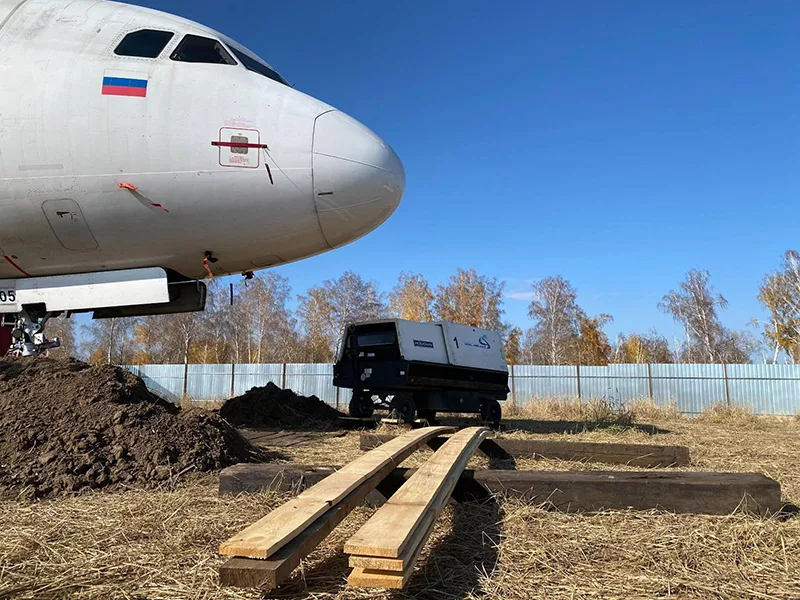
And here's the mane we've heard about so many times this morning. On the mane is an Airbus A320, landed in the wheat. As you drive closer, a corrugated metal fence appears. The gate in the fence is open. To the left is a trailer and a small caravan where the private security guards guarding the plane live.
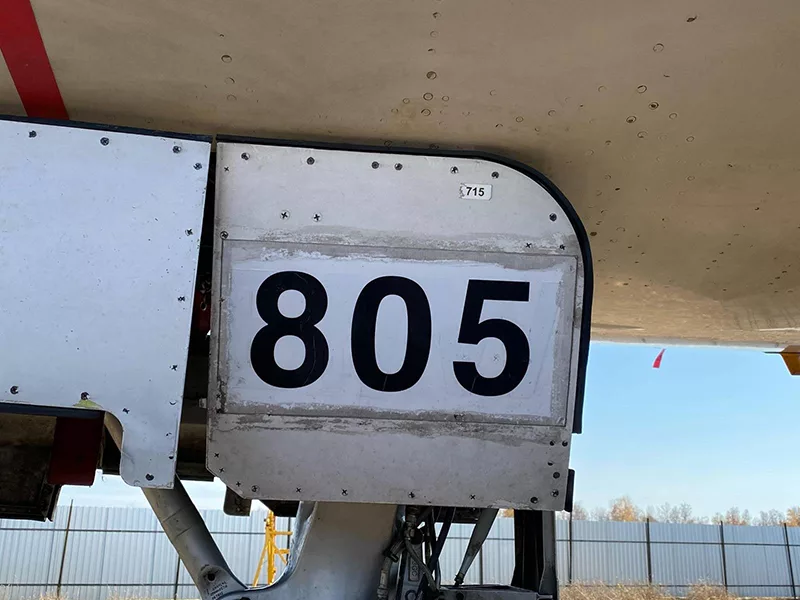
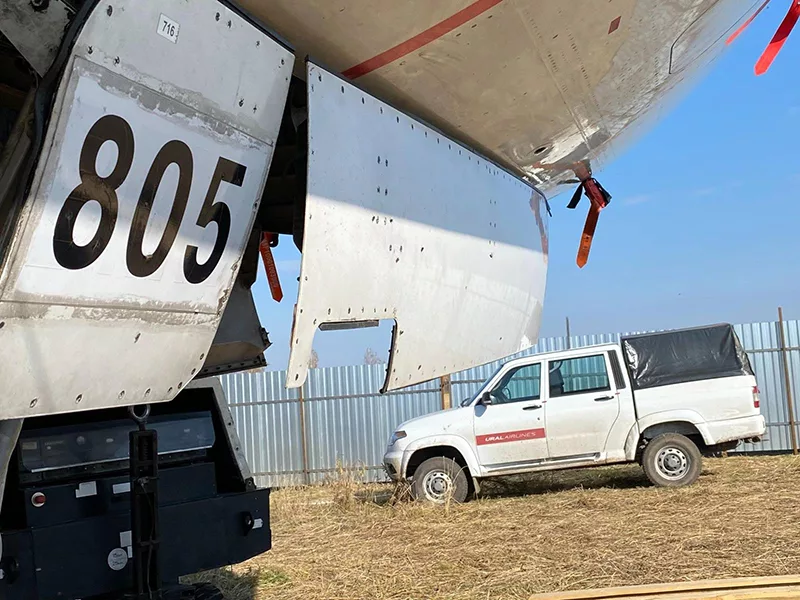
In the pen, the landing gear rests on massive logs in earthen trench foundations. The wind whips at the aircraft's body, seals tied with red and white ribbons. The belly is hollow, where the fender liner and engine once were. Only two barrels of kerosene were drained from aircraft number 805, says Alexander, a security guard for the Novosibirsk company "Podrazdelenie D." Blue barrels marked "Gazprom" contain the remaining fuel the pilots needed to reach the Tolmachevskaya airstrip.

Nearby is a transparent tent with a sealed entrance. Ural Airlines engineers work here on a rotating basis. Their pickup truck is parked opposite the cockpit. The next shift is on its way. In the right corner are several blue jacks.
Around the plane is a wheat field trampled by hundreds of feet. The red and white ribbon with which the Investigative Committee investigators wrapped the landing site is woven into the rustling wheat.


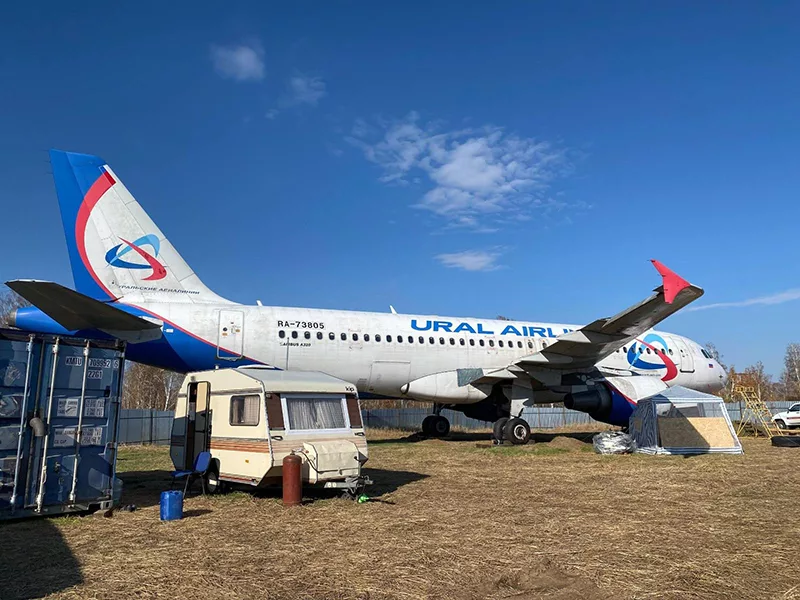
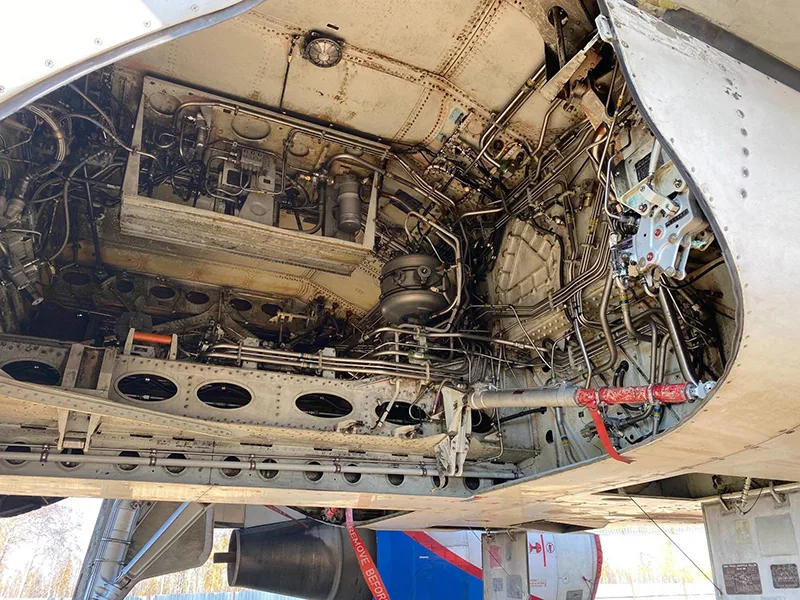
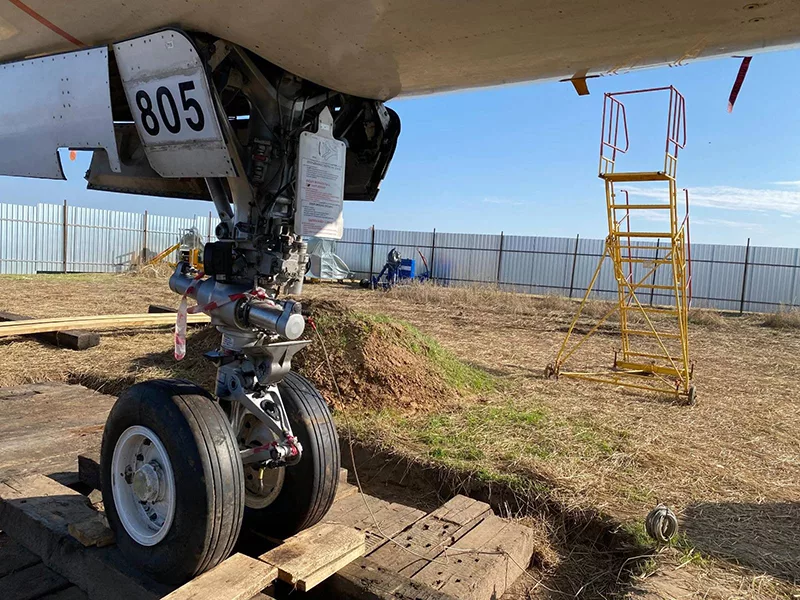
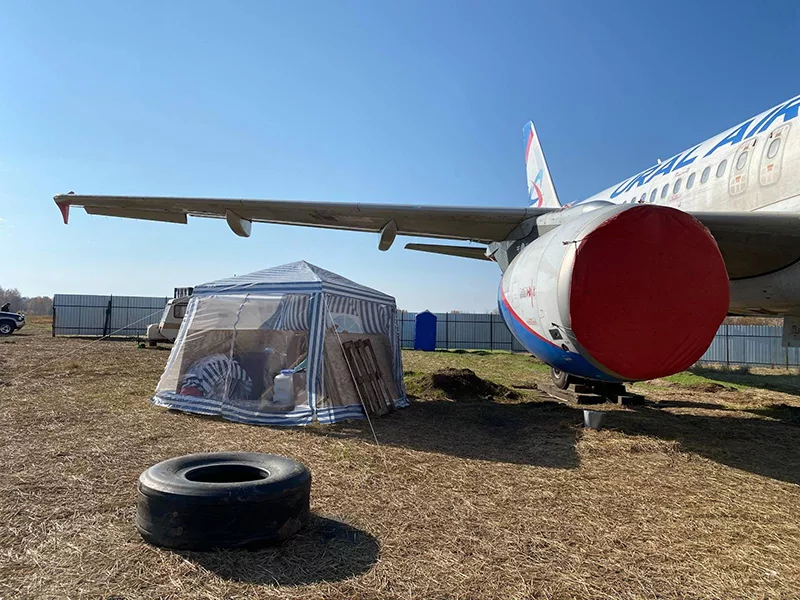
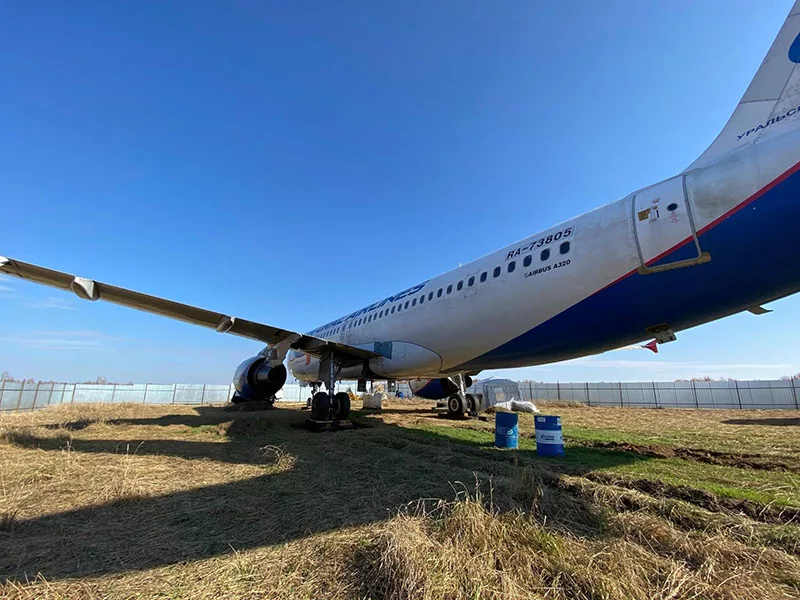
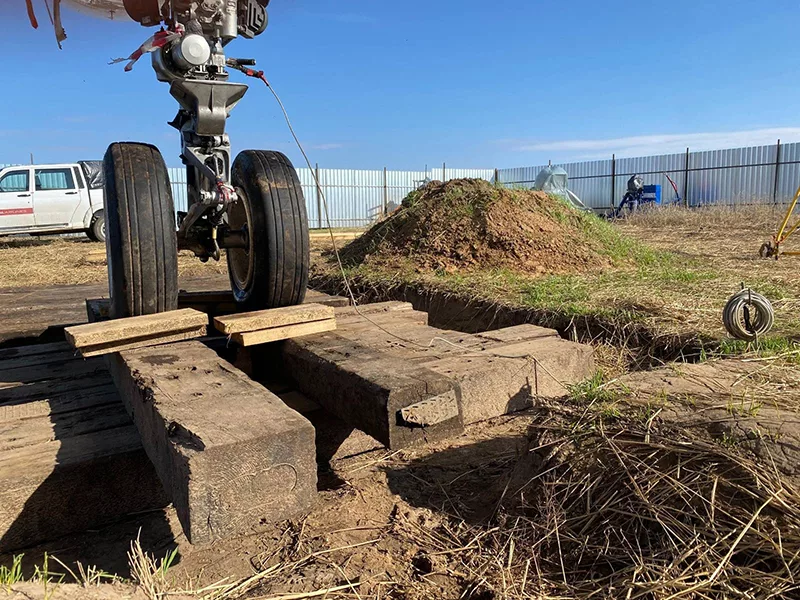
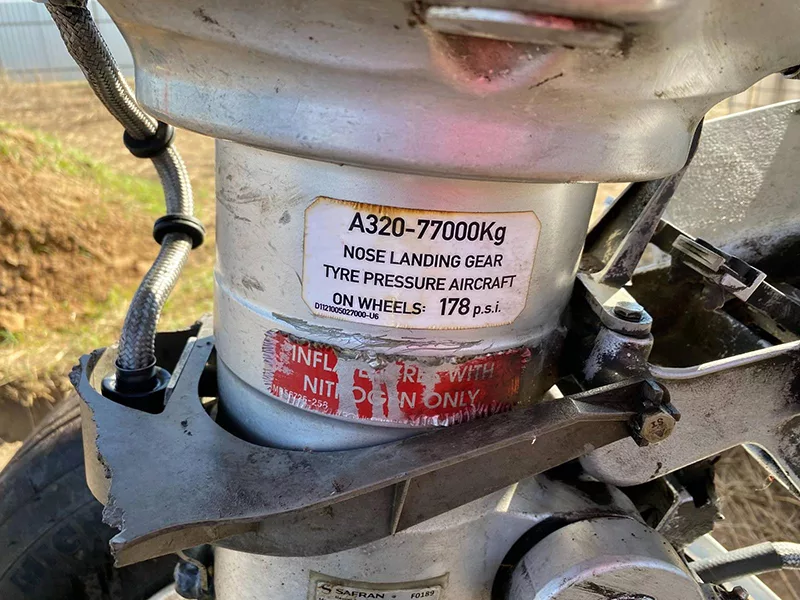
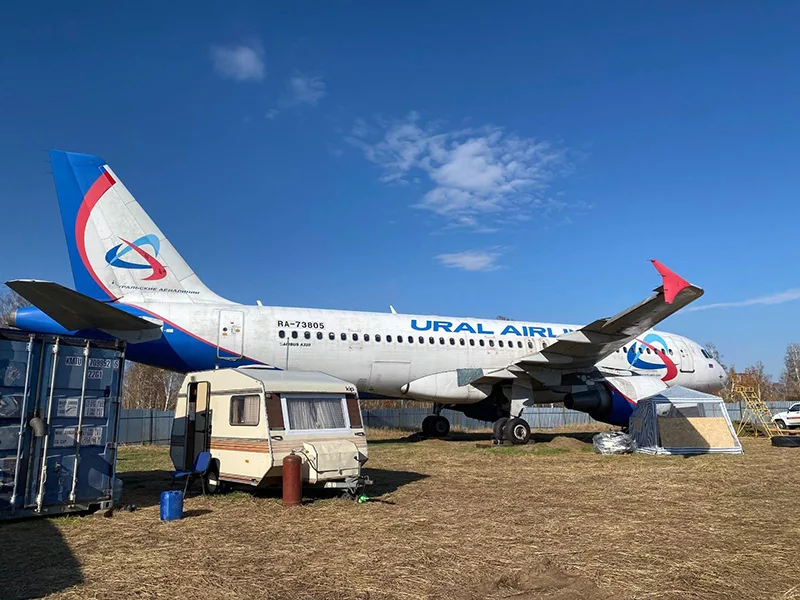
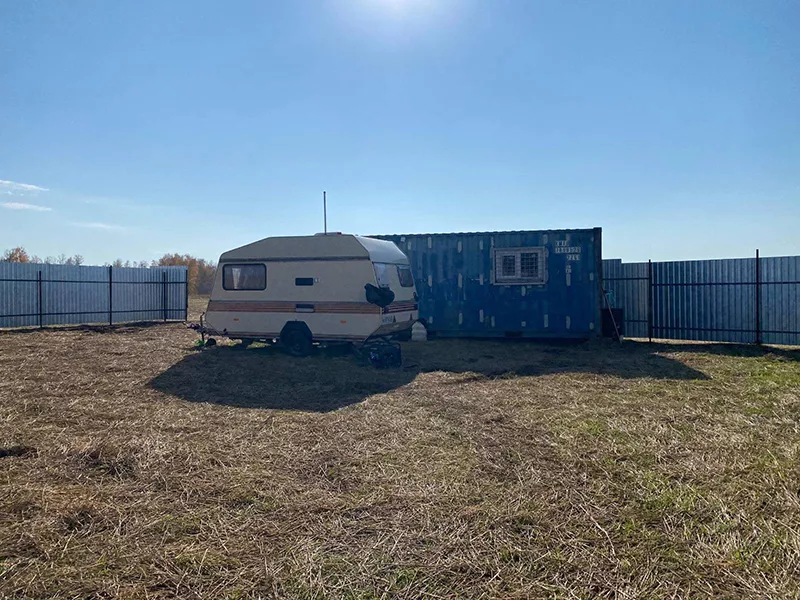
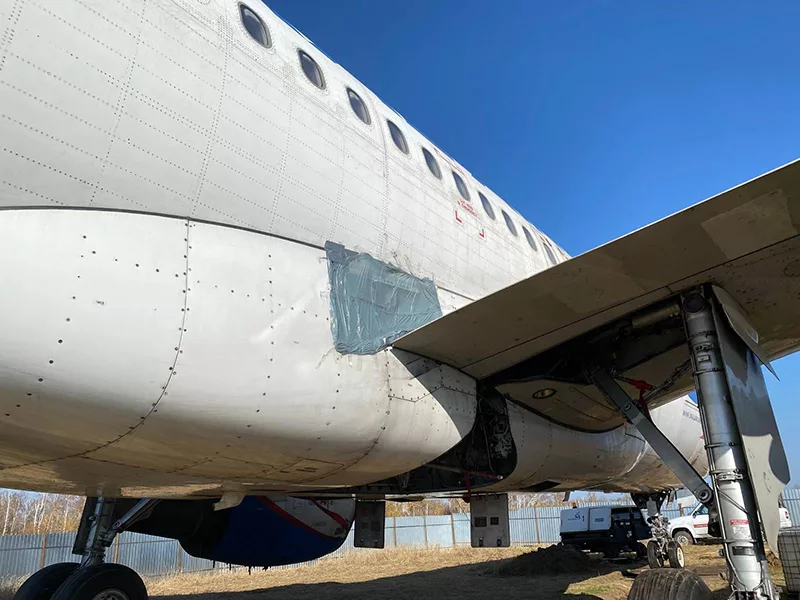
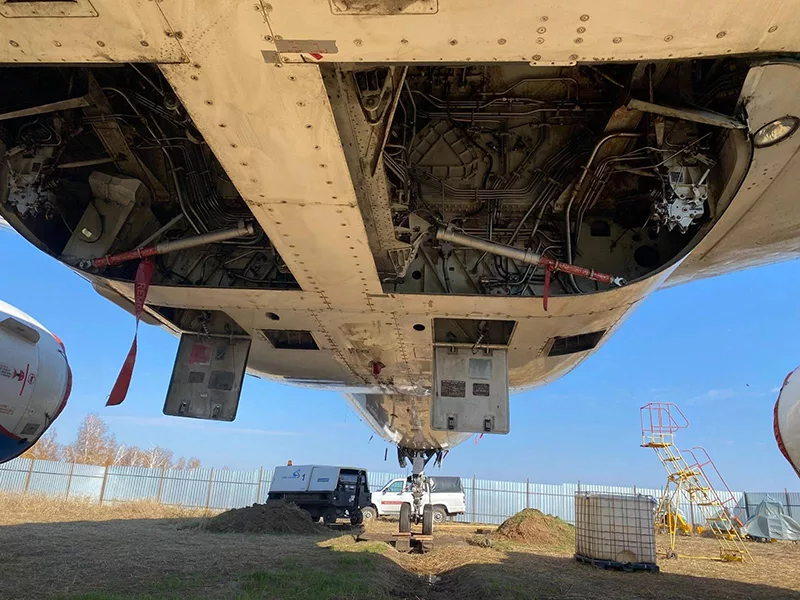
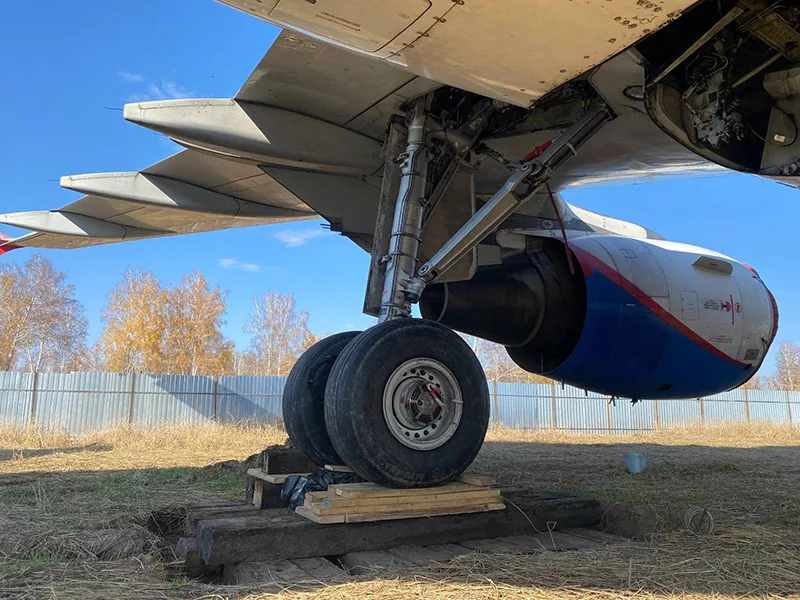
"This is the landing gear, I don't know why Ural Airlines brought it," the security guard said, pointing to the tires. He said investigators don't come here anymore, though the air traffic controller who was flying the plane did.
"When will it take off? Not until after the New Year," Alexander continues. "It landed there, behind the fence, you see, about 600 meters of track. And right here is the spot where it stopped."
“The plane was cleaned, the engines and systems were checked,” he says.
"They'll also be removing the seats to make takeoff easier. Then, where the landing gear folds, he has two covers—one was blown off and stuck in the ground, and the other was ripped off, and the technicians removed it. They drained the kerosene. That's two barrels in total."
As far as he knows, there are no plans for transportation yet.

"Technicians will be back in a week to see what else needs to be removed. Everything will be returned when it's time to take off. They'll bring the slabs, lift the plane on jacks, and put the slabs underneath. They'll build the runway. As far as I understand, in the winter. They don't want to build the runway with slabs now—it's too expensive. Logistics aside, let's leave it all. The runway will be made of ice in the winter. Taking off won't be a problem."
— Do many people come to see it?
— A lot! People come straight from other cities to look; yesterday, twelve cars arrived, then more. The locals, however, have already seen everything. There used to be no fence here. They put one up two weeks ago. It's somehow nicer now. There's a lot of wildlife running around here—deer, some goats. They say there are bears, but we haven't seen any yet.

Where the emergency slides were deployed, the windows are taped over. Next to the plane is a lightweight slide. Apparently, they brought technicians with them. While I was photographing the plane, I counted over twenty people driving up in different cars to take selfies.

In Moskovka there are only two streets, where less than a hundred people live.
The goal is to find Nadezhda Komarovskaya, who is said to have seen the plane landing in the field. A young woman emerges from a blue gate, pushing a stroller with a one-year-old baby along the side of the road, accompanied by music playing on her phone.

Vladislava Bessonova, 30, from Novosibirsk, is visiting her daughter with her grandmother. When the emergency struck the village on September 12, she says, it was a flash of shock—a plane crashed in a field. An hour later, everyone knew everything was fine and everyone was alive.
"We couldn't hear it circling and landing. Then we saw the fire trucks, the ambulance, the Ikarus bus, and a lot of vehicles heading that way; they were already evacuating people."
— Is this now the main attraction of Moskovka?
"Yes, well, not exactly the most important one, but it's rare for a plane to land without any consequences, everyone alive and well, and just a little shock. Many were worried and went there, maybe to help. But then it turned out the passengers were being housed at the Ubinsky District Community Center."
Now the main topic is how the plane will be removed.
"Everyone says different things. Some say they'll build a special pad for it to take off, that there's enough space here. The runway here is one kilometer longer, in Novosibirsk it's three, and here it'll be four. Then they say no pilot will take it on, won't risk it, there's not enough space. Then they say they'll dismantle it and haul it away in pieces."
We reached Komarovskaya's house. A rod stuck in the door indicated that the owner was not home. A tractor rumbled nearby. I headed toward it.

Past a well crane and sheep with an electric shepherd—an animal that receives a shock to its nose, keeping it within the fenced field. The flock belongs to Vladimir, who has been retired for five years. Until the age of 60, he worked on the Lenin collective farm, managed by farmer Komarovsky, who, as it later turned out, is the brother of the woman I'm looking for.
When the plane landed, Vladimir was digging potatoes with his wife and neighbors. As soon as the news reached their house, he says, he rushed to the field.
"I was there an hour after landing. Police, the Ministry of Emergency Situations, a cordon. We stood about 10-15 meters from the landing site. And before that, when it was landing, we were digging potatoes; some plane was apparently looking for it. The plane circled above us three times, just like that, right above us. It's so interesting, it's all so new to us."
— Have you ever flown on airplanes?
"Honestly, I never once, even in the army, had to be on a plane. Now it's a pilgrimage. Cars keep coming and coming every day."
— What do they say, how will they clean it up?
"Whoever says it'll take off when it freezes over? I think the pilots did a great job, at least they saved the crew. How could they land them like that in the field? We're all amazed. I think the pilots are professionals, they did a great job landing them like that, keeping everyone safe. I've heard some complaints about them. I'm against it; on the contrary, I'm for them getting an award. Well, the plane, whatever, it's just a piece of iron, but the crew—not a single one was hurt. That's a huge surprise; it means they're professionals."

— Have people in the village stopped discussing the news?
"It's calmed down a bit already. We experienced such a miracle. Some people have lived here their whole lives and never even seen a plane. Do you understand? It's like a miracle happened in Moskovka."
— How did I find out? Our accountant, Nadezhda Komarovskaya, lives next door. We were digging potatoes—my wife, me, the neighbors, my wife's sister lives here—and then Nadya runs up and shouts, "Didn't you hear that the plane was about to make an emergency landing?" No, we hadn't, and it had already landed. And everyone was there. And I went there to see. There were no passengers left.
— Will you go watch the takeoff?
- Of course!
Nadezhda Nikolaevna was found in the garden of her daughter Vera, who lives in the red mansion across from her mother's house. It turns out she didn't witness the landing itself. Nevertheless, today she's the most popular and sought-after journalist. Lera Kudryavtseva from "Stars Converged" came to visit, inviting her to Moscow. NTV showed it.

— How did it happen? I was in the garden, my daughter was home. She called. And her husband was working in the next village. There's a village called Raisino near Kamenka. He was flying there. My husband has a friend in Kamenka, and at that moment he was working in the field on a tractor. He says: "Kolya, a passenger plane roared towards you, flying low. Roaring, coming in for a landing." And my daughter says to her husband: "Don't be silly, I'm going to dig potatoes." She calls me: "Mom, you went out to the garden earlier, did you hear anything? The roar or the hum of a plane?" I tell her: it's quiet, all the neighbors are in their gardens. We're digging, and she calls again: "Mom, ambulances and fire trucks are coming down the highway toward the cemetery." I drop everything and run to her. She's already standing on the highway, and I can see the plane from there. There, to the right of the warehouse, you can see the plane in the field. The head of the Yermolayevka administration says to my daughter, "Vera, stop and show the cars where to go." There are a lot of cars coming from Ubinka. It's funny now, but back then it was scary. I stopped one car, got in, and flew there. My daughter screams, "Mom, where are you going?"
I arrived there, there were a lot of people, buses full of people were already coming the other way. I approached, and there were the pilots and two flight attendants, the captain standing off to the side, talking on the phone. Everyone was scared. I approached them, saying, "My dear girls, how did you cope with this shock?" They said, "What could we have done? The captain warned us, and we went up to the cabin and told everyone, and now we're all on board." I said, "My dears, we need to call Vladimir Vladimirovich so he can nominate you for an award." They smiled. "Now, when you fly that way, at least wave. We're in Moskovka, and you might be in Moscow. Don't forget Moskovka." Thanks to Oleg Fyodorovich, the head of our Ubinsk administration, everything was organized; people were quickly evacuated to the community center and sent wherever they needed to go.

50-year-old daughter Vera Medvedeva smiles as she listens to her mother.
"On the highway, when we were transferring passengers from one bus to another, I asked one of them, 'Where were you flying to?' She said, 'To Sochi,' and I said, 'Well, with a transfer in Moskovka.' People were emotional, maybe scared, maybe shocked. It wasn't clear. It was stressful. 'Well, now it's your second birthday, come to Moskovka to celebrate,'" she adds.
— When I came back, Vera asked, "Mom, do you have any sense? What if the plane had exploded?" I said, "I didn't think it could explode. It landed so well. No one was hurt." They say they're blaming the pilots now. Well, that wouldn't be necessary, they'd be happy that everyone survived, to land in a wheat field! In Moskovka, which is already forgotten by both God and the devil, this village is already disappearing. And the plane landed. Since the 12th, everyone has been coming and coming, cars coming and coming. Journalists are driving us crazy. And there are weddings. Fifteen cars a day scurrying back and forth.
70-year-old Nadezhda Komarovskaya worked in the local community center for over twenty years and was a member of parliament.
— What's going on here in Moskovka? The phones aren't working, there's no reception. Thank God, they fixed our road. I've never flown on a plane in my life, never. You're the ones who fly, and where are we supposed to fly?! I was cleaning a chimney and fell off the roof. I climbed up a ladder and fell, — she laughs. — No, no. We don't know how anyone can fly here, they land one after another, sometimes in the corn, sometimes in the Moskovka field, what are you talking about? You're flying, I see! Be careful! No one in our village has ever flown. The guys who served in the army, maybe they did. My grandson flew on a business trip to Moscow.
Nadezhda Nikolaevna is worried about the pilots who may be punished for their mistakes.
"This needs to go to Putin, how can we punish them? Why punish these pilots? It's impossible! You can just write it down. Nadezhda Nikolaevna saw it, she was right there, next to the plane."
Before the Ural Airlines plane landed in the field, the most pressing issue for the villagers was communications.
"You run to the other end of the garden just to say a word. The tower is standing still. The laptop is barely moving. Before the plane, communications was the most important issue. No MTS, no Tele2, no coverage whatsoever. Moskovka was a forgotten place, but now everyone's traveling! Our plane landed, right behind the gardens! Everyone's wondering how it landed, how skillfully they handled it, how the passengers didn't notice. It's not just newlyweds who are coming to the plane anymore; passengers from the ill-fated Sochi-Omsk flight are also returning. Yesterday, several passengers arrived from Omsk and said they didn't understand where and what was going on during the landing, everyone was in a hurry and scared, and a month later they came back to check," Vera says.
The miracle, as the locals call the landing, instantly made their small village world-famous. The second episode will gain popularity with the takeoff. The topic of "how the plane will leave Komarovskoe Field" is currently trending.

Alexander Komarovsky, chairman of the Lenin collective farm, learned from district head Konyuk about the plane's landing before the plane's captain had chosen the field where the first wheat had sprouted after fallow. He only went to the aircraft on the third day.
"I left two days later. What was there to do there on the first day? It wasn't the plane that damaged us, but the buses, fire trucks, ambulances—there were a lot of people there," he lists. Now he's trying to get the owner of the Ural Airlines aircraft to resolve a vital issue: whether or not to plow the field. If he doesn't plow now, he won't be able to plant in the spring and will lose the income from the harvest.
"We have 60 hectares, with a yield of 20 centners per hectare, not bad for this year. One centner costs 10,000 rubles, so we've harvested a total of 1.2 million. Machines destroyed 10 hectares, which is 200,000 rubles. I called Ural Airlines and said we're going to plow this field, you come over, and we'll figure out what's right for you to leave unplowed. 'Yes, yes, we'll come,' they said indignantly. 'And if it's better to leave it all unplowed, then give me what I got from it this year, just compensate me for that amount.' I even said more: 'Come over, maybe not the whole field, we'll plow the edges, leave a runway for takeoff, maybe then you won't have to pay anything,' but no one's coming. I've talked to them twice. They're silent. So I'm starting to plow this field. It's long overdue. The wheat was harvested two days ago. They say they're planning to take off after the New Year. That's why they say so they don't have to plow.
A week after his attempt to plow the airfield, Alexander Komarovsky announced that an agreement had been reached between him and the aircraft's owner, Ural Airlines.
They asked us not to work. They decided not to work. They promised to pay.
40 hectares out of 60 will remain uncultivated: approximately 800 rubles will be reimbursed. This means the Airbus A320 will be able to take off directly from the field. And the village of Moskovka will once again be featured on the news.

