
"The victory of Nazism must be achieved."
Pictures at an Exhibition. A propaganda exhibit about "Nazism" in Ukraine has opened at Khabarovsk University.
On June 10, in the midst of the semester, the Pacific National University (PNU) opened the exhibition "Ordinary Nazism." The "artifacts," as those present called the exhibits, brought from Ukraine, were intended to convince viewers of the necessity of the "SVO" and the existence of Nazism in Ukraine. The event passed quietly and almost unnoticed—many students were unaware that "such a thing" was taking place at the university.
The exhibition "Ordinary Nazism" is being held at the Victory Museum in Moscow and will run until April 19, 2023. It features over 200 exhibits brought from Donbas. Part of the exhibition is being toured throughout Russia. The exhibition has been shown in Vladimir, Makhachkala, Rostov-on-Don, Barnaul, and Ulan-Ude—more than 20 cities in total. UrFU students also visited Yekaterinburg. ruined The exhibition banners were quickly replaced by the exhibition organizers, and pro-government television channels called on people to inform on opposition-minded students. The exhibits were also taken abroad. To Abkhazia.
No pass required
It's usually impossible to just walk into Pacific National University: the security guard at the turnstile on the stairs to the main building always sternly asks who's going where. Sometimes he asks for accreditation or directs you to call a staff member to meet you. These rules don't apply to "ordinary Nazism"—you can enter such an important event for the university without any problem.
The exhibition is on display in the reading room of the Faculty of Social Sciences and Humanities. Finding the right room the first time at the university is always difficult: the buildings are connected by stairs, corridors, and passages, making it easy to get lost at Pacific National University. I ask students passing by where the exhibition is opening that day. The students I meet either wave me off or react with bewilderment—they've never heard of it. But they help me find the room.
"What, some kind of exhibition?" the girl asks, surprised. I quickly explain what we brought to the university. "Never heard of such a thing!"
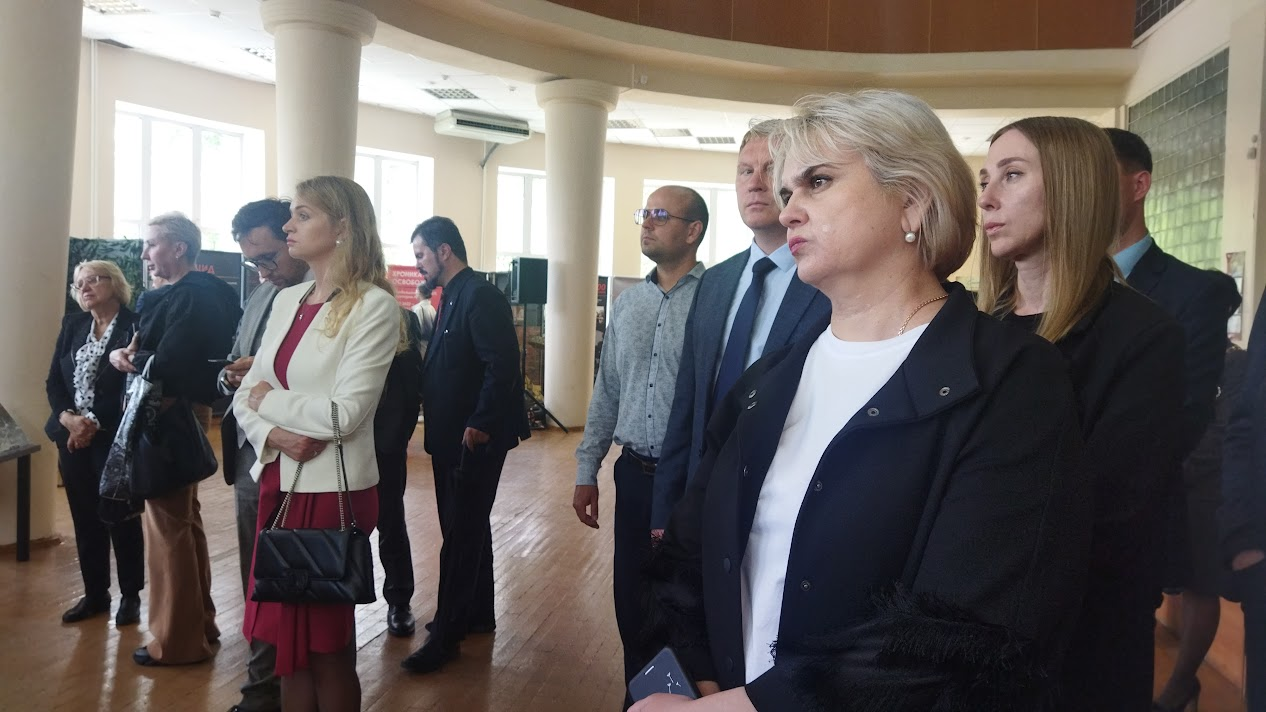
There are about ten minutes left before the grand opening, and no more than a dozen people are in the hall. Local officials, university staff, and representatives of the Legislative Assembly and the Civic Chamber have arrived. There are no student volunteer groups in sight, but about fifteen people have arrived.
The entire exhibition consists of six mini-exhibitions dedicated to different periods of Ukrainian history. The backdrop consists of printed banners with photographs and captions. In the center, beneath them, various objects are displayed—from Ukrainian military uniforms to shell parts. The exhibition organizers refer to these as "artifacts."
The exhibition begins with the Second World War - from there, with the creation OUN UPA, according to the creators, are rooted in "Ukrainian nationalism." The illustrations include an archival photo from Ivano-Frankivsk, where, allegedly, Ukrainian women in embroidered shirts are greeting Hitler with a march. Hitler, however, is not in the photo.
The events that follow follow Ukraine's independence. A separate exhibition is dedicated to MaidanAfterward, the focus became increasingly on "loss of memory" and how Ukrainians "rewrote" their history. According to the organizers, since 2014, the Ukrainian Armed Forces began using civilians as human shields, and NATO no longer supplied humanitarian aid but lethal weapons. Several printed displays featured Putin's quotes about the need for a "Russian military base." The overwhelming joy of residents of Ukraine's regions at the arrival of the Russian world is emphasized.


Several stands from the exhibition.
The organizers emphasize that all the "artifacts" are authentic. They were collected by a "special inter-museum group," notes Ruslan Gagkuev, chairman of the Russian Historical Society, who arrived in Khabarovsk for the exhibition opening, with some pride. The organization also held a series of thematic lectures for local historians in the city, and this fall, it is announcing a thematic museum forum dedicated to Ukrainian Nazism. It is said that at this forum, specialists will be able to discuss "pressing issues and summarize the work accomplished."
The main theme of Ruslan Gagkuev, judging by his published writings, the 1917 revolution. He appears frequently in the media and says that the revolution became "the greatest tragedy in the history of our country." In his speeches, he also often saysThat Western countries have forgotten their own history and never knew Russia's. Russia, for them, has always been a competitor, meaning the West "always has a desire to somehow remove our country from the world stage."
"We've received numerous requests for this exhibition, and we've now created three displays that can be shown simultaneously in different cities across the country. Members of the working group have been working in Ukraine since the very beginning of the Battle of Stalingrad, collecting thousands of items there. All of this is being consolidated at the Battle of Stalingrad Museum in Volgograd," explains Gagkuyev. "Here you can clearly see what a Nazi revival could bring. None of us could have imagined such horrific consequences. We see the evil that our soldiers and officers are currently fighting, struggling against."
Other guests at the event agree, and they also talk about the need to show the exhibits to as many people as possible.
"We see not just words, but artifacts that demonstrate systemic genocide based on ethnicity. No matter how difficult and stressful it may be, we need to talk about this, show it, and educate young people," says Pacific National University Rector Yuri Marfin.
Yuri Marfin has been rector for a relatively short time, since 2022. In January 2024, he met Putin at Pacific National University. social networks The new rector is doing everything that a university leader should nowadays: posts about Putin's address to the Federation Council, support for his plans to participate in the presidential elections.

Another guest, Galina Kononenko, a member of the regional Public Chamber, said that young people are currently being indoctrinated with "historical untruths."
"We're delighted that such an exhibition has come to us; it leaves a profound impression; it's hard to erase such materials from your memory. Events like these are essential for every Russian citizen," she says. "The victory of Nazism must be achieved without fail!"
Apparently overcome with emotion, Galina Kononenko clearly overstepped the bounds of the popular Criminal Code article 354.1—the one on "rehabilitation of Nazism." But, just in case, she has mitigating circumstances. The event was important and patriotic.
The CEO also calls the exhibits “artifacts” Grodekovo MuseumIvan Kryukov, chairman of the regional branch of the Russian Historical Society, believes that "all these signs of Ukrainian Nazism and crimes" must be documented and collected. And from what is presented today at the Pacific National University, "everyone will draw their own clear conclusions."
The OSCE flag and the adventures of Mykytka
Various objects and photographs from RIA Novosti are intended to convince visitors of the existence of Nazism in Ukraine.
On the first pedestal, beneath the story of the first “Nazi battalions” in modern Ukraine, there is a special forces helmet, a cap and scarf of a football fan from Odessa, and a periodical magazine "Gromadianske Suspilstvo" (Civil society).


Further on, Ukrainian Nazism is "proved" by yellow-and-blue chevrons, military uniforms, and khaki T-shirts with the Azov Regiment symbols (an organization banned in Russia). On the shelves are books by Ukrainian researchers about the defense of Luhansk Airport. Also here is a publication Dmitry Korchinsky, a former candidate for the presidency of Ukraine (he received less than 1% of the vote) and a volunteer on the side of Ichkeria in the first Russian-Chechen war, next to - book by British-Canadian political scientist of Ukrainian descent Taras Kuzio. Among others, there's "Alien Rashka" by Elizaveta Melnichenko. In 2017, it was published in Russian, but social media commentators were particularly displeased. Illustrations It contains, in particular, an image of Vovan Vovanovich Putkin, “the lifelong dictator, lumpen tsar, and ruler of the wadding federation of Rashka.”


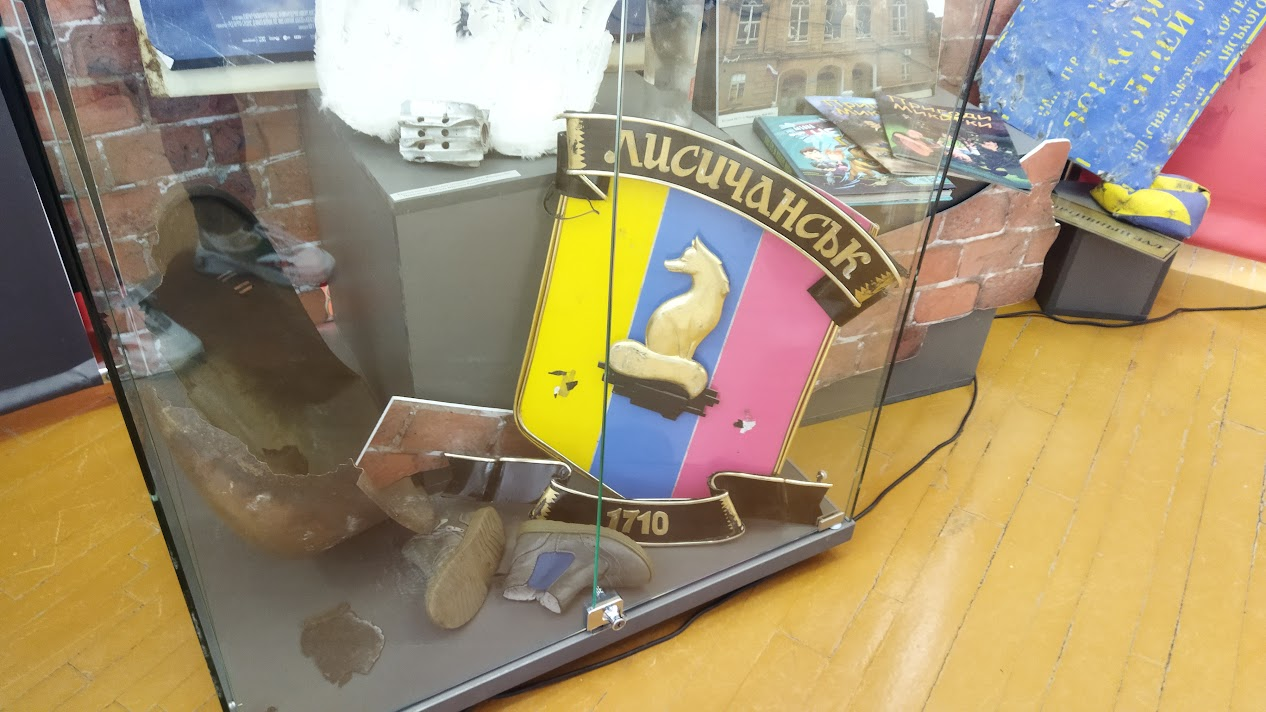
Further on is a "shot-out" STOP sign, covered in tiny holes, and ration packets with English writing. Nearby is a uniform, according to the tour guide, of a NATO mercenary, which is indistinguishable from the uniforms of the Ukrainian Armed Forces and the National Guard displayed behind glass. The one behind the glass is defaced by fellow soldiers. Next is a weapons crate, shell fragments, a sign from some lyceum (the name is difficult to make out) in the Luhansk region… Binoculars, several issues of the comic book " Come in (adventures) of Mikitki" and the OSCE flag. Why even this flag illustrates Nazism is unclear—the organization's international observers are present in virtually all military conflicts (except in Donbas—Russia withdrew them at the beginning of its full-fledged invasion on March 31, 2022). A separate glass display case contains a cross and a destroyed church candlestick—proof of the destruction of Orthodoxy in Ukraine.


Visitors to the exhibition show little interest in the shells, crosses, flags, uniforms, and books. Most pass by without lingering. The exhibits attract mostly photographers and cameramen from local television channels. Later, these channels will report on the exhibition, dedicated to the "tragedy of the civilian population of Donbas," calling the exhibits "evidence of the crimes of the Ukrainian regime" and "evidence of the real state of affairs in southeastern Ukraine."
The students were only interested in "Mikitki, come here".
"What do you mean, anything in Russian will happen here?" one of the students quietly protests. He will later introduce himself as Veniamin.
"And look at this! Are those Russians or something?" his classmates chuckle in surprise.
"It's complete Russophobia! Orcs, look, they called Russians orcs!" Veniamin leafs through the magazine carefully.

The older audience sat a little further back, near the sociology books—the same ones that were always on display here in the reading room. They occupied a few chairs, chatting quietly. "We won't argue with the party and government line," one of the visitors, a gray-haired man wearing glasses, quietly says to his interlocutor.
A tour from a Mariupol museum curator
For those unable to examine the "artifacts" themselves, a tour was held after the official opening, led by Natalia Kapustnikova, the former director of the Mariupol Museum of Local History. On February 24, 2022, she supported the Russian invasion. In Ukraine, she is considered a collaborator, accused of helping Russian troops establish themselves in the museum building and transferring some of its exhibits to Russia, including paintings by Arkhip Kuindzhi and Ivan Aivazovsky. Her name is is listed in the Ukrainian database "Peacemaker". How пишет Mariupol city portal, after the city's occupation, she left for Russia, then returned to Mariupol, where she convinced colleagues of the need to organize an exhibition similar to the one in Khabarovsk.
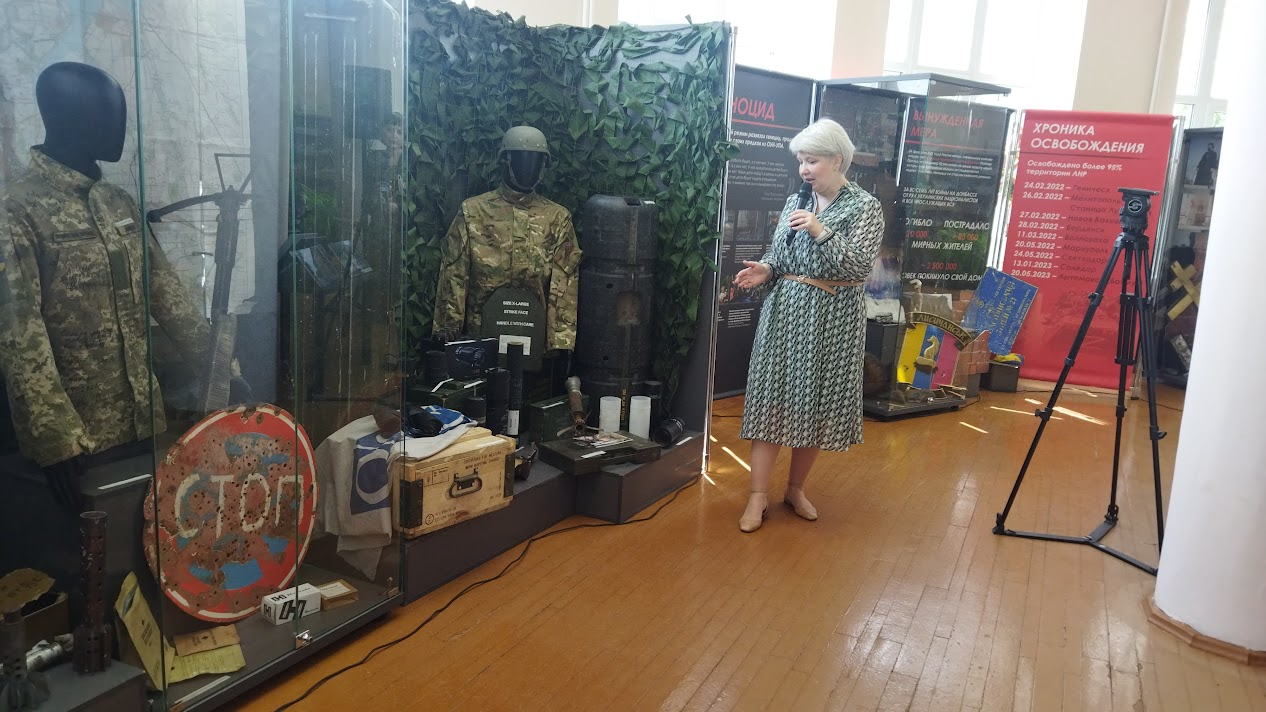
During the tour, Kapustnikova talks about the rise of Ukrainian nationalism in the 20s and how nationalists exterminated civilians during World War II. She explains that their "activities were aimed at creating an independent Ukrainian state," as Kapustnikova and Russian propaganda insist—using only terrorist methods. The Soviet army "liquidated" them, but "their ideas remained alive," and "Ukraine began fighting for its independence again." A book by the second Ukrainian president is cited as evidence. Leonid Kuchma "Ukraine is not Russia." Since the book's publication, the country has allegedly begun to operate under this slogan.
What follows is a story about the violation of "constitutional norms" during the election of Viktor Yushchenko, the beginning of the "rewriting of history," and how nationalists in Ukraine adopted "Hitler's methods." The guide calls the Maidan a "bloody coup d'état," and "Golden eagle" — the last unit that tried to "defend statehood." In 2023, five Berkut officers were convicted for the shooting of peaceful demonstrators. sentenced to varying terms - from five years to life imprisonment.
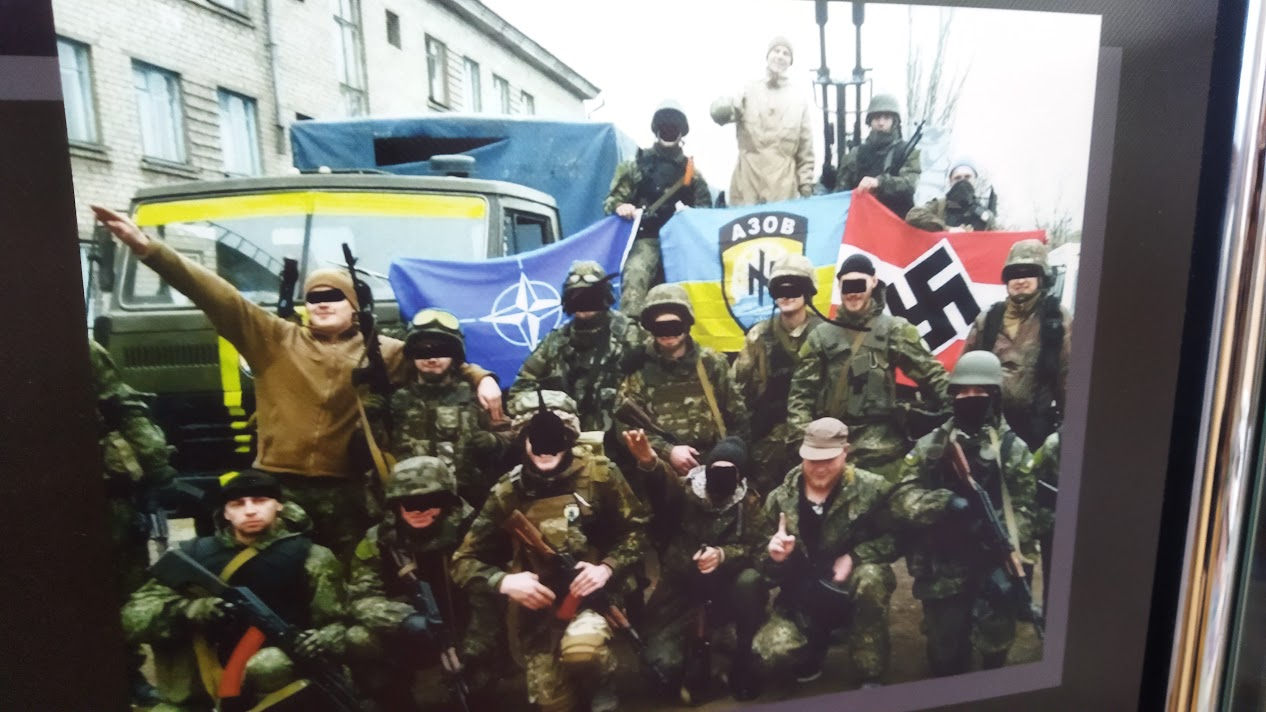
In 2014, Kapustnikova continues, Azov was formed. A photograph posted on one of the display stands supposedly suggests the Nazi nature of the battalion, which was one of the first to deploy to the Donbas after it declared independence. It depicts several people holding flags bearing Azov symbols, NATO symbols, and a swastika. The image was first published on social media in 2015, and has since been actively used by Russian propaganda. Researchers argue The image's authenticity is questionable. Those who believe the photo is fake point to evidence of editing, suggesting the swastika was added to the photo.
Kapustina then begins to contradict herself. She claims that when regular troops were sent against the "civilian population of Donbas," it was a civil war. She doesn't explain why Russian troops came to Ukraine and became embroiled in a civil war, or why they later began "denazification and demilitarization" in another state's internal conflict.
The guide continues—about the extermination of the male population, the shattered economy... For a moment, you forget yourself, it seems she's suddenly started talking about Russia. But no, it's all about Ukraine.
"You're probably seeing news reports of people being literally grabbed off the streets and dragged into transport to be literally thrown to the front, where the life expectancy of such a soldier is a matter of hours. What does this mean—the destruction of the male population? It's about demography, and it's about the economy. In other words, it's a complete collapse in economic indicators. This is likely the end of Ukraine's economic recovery. It's the destruction of a normal, sensible population, it's the fight against the opposition, it's the re-forging of views on change and the rewriting of history," the guide offers, spitting out a free-flowing series of associations.
The Mariupol museum worker summarizes her story by saying that the Ukrainian army is destroying churches, using civilians as human shields and has destroyed Mariupol Drama Theater, in which, according to her estimates, they died, 1500 peopleKapustnikova continues her story by saying that Kyiv continues to receive weapons from NATO countries. Donbas, Kharkiv, and Zaporizhzhia have been reduced to rubble. What is this if not proof of the existence of Nazism in Ukraine?
"I'll go tomorrow after class!"
By the end of the tour, the students had already dispersed, leaving only the Grodekovo Museum and university staff. Only one student listened to the end of the story—the same Veniamin who found Russophobia in the comic. He's smart and formally dressed: white top, black bottoms. He says he came out of curiosity, having learned about the exhibition from chats.
"I'm interested in this topic; it's all I watch in the news. I have friends who are fighting, some at the front. Sometimes they come back on vacation, and we talk. They have everything they need there, and they don't even ask for help. I myself was from Ukraine two generations ago, but now I only consider myself Russian. So all this needs to be shown so that people can see what these guys are doing there and why."
— What didn’t you like about the comics?
"Well, look, the Russian fighter is an orc, the Russians are demonized to the max. The Ukrainian Armed Forces, on the other hand, are as kind as can be. And what is this anyway, showing children murder?"
Evgeny, an employee of the Grodekovo Museum, agrees. He has already left the reading room and is waiting for someone at the exit. Evgeny believes that after the end of the "SVO" program, more historical sources will become available, but it's important to begin preserving historical memory today. Grodekovo staff currently assist departmental museums in organizing similar exhibitions.
"We maintain online catalogs listing our Khabarovsk residents, who unfortunately died, with the Order of Courage. The lists are also posted on the museum's website," Evgeny shared his achievements.
"It probably won't be like Moscow, it won't be as powerful," one of the exhibition visitors said ruefully in the smoking room. "And I don't know if it was worth bringing the equipment. But anyway, guys, we should go and see it tomorrow after class. It needs to be shown!"
"We need to show dead civilians and destroyed houses," his comrade says sadly, as if to himself. But he doesn't want to discuss his views with the journalist in more detail.
"They forget about us, philologists, and that's a good thing."
We asked ten university students, and none of them knew about the exhibition. According to Ksenia (name changed), a student in the Philology Department, she first heard about the exhibition from a NeMoskva journalist. The Philology Department is located in the former Far Eastern National University building in the city center, separated from the main PNU campus, which is located in the Severny district. The exhibition opened in the Severny district, although it's hard to say it was relocated to a remote location—it's the main building, after all.
"You know, they have a rector there, and the entire administration, and Putin visited them there, and they opened some kind of center to combat extremism... We don't have much contact with the 'northern' ones. People often forget about us philologists, to be honest, but it's good that we're such outcasts. We even have liberal professors who only ask us not to turn them in when they make dangerous statements. In my circle of friends, there are no people who have an inappropriate attitude toward what's happening in the country. Although, maybe it's just my environment, I don't know."
— There was no order to visit the exhibition?
"No, we're busy with exams and exams, so we don't have time for exhibitions. There was a Z-poetry evening once. They pulled us out of class, saying there would be an evening like this. But more than half of us simply didn't go. My classmates told the class monitor that they had nothing to do with Z-poetry, and it's hard to call it poetry, art doesn't serve such things." I know someone was given a condition: either you read a poem or you'll fail your exam. I think the fourth years went off to disgrace themselves... Maybe it really is a nightmare up there in the "northern" building. I didn't even know about that exhibition, and now I'm horrified. It's good that it wasn't in our building, at least, and we've managed without such "agenda-driven" mass events for now. I think it's shameful to even hold such propaganda events at the university.
The exhibition will run until July 14, 2024, after which it will travel to Kazan. This entire large-scale project of the Russian Historical Society supported The Presidential Grants Fund. In 2022, 5,517,080 rubles were allocated, with co-financing amounting to an additional 3,956,680 rubles. In the second special competition of the Cultural Initiatives Fund in 2022, the exhibition project got Another 10,000,000 rubles and indicated co-financing of 4,204,645 rubles in the application. In total, the creation cost more than 15 million rubles.
The exhibition's organizers lament that Russians are experiencing a "slight decline in citizen interest in being kept informed about the progress of the Second World War." And this project is about the "Nazi rise to power in Ukraine." should Maintain the level of interest the state requires. However, it seems things didn't go so well with the Ural students who defaced the banners. Will the Khabarovsk students be receptive?

