
The Skull of Major Pavlutsky, or the Victorious One over the Chukchi
On March 14 (Old Style), 1747, the Russian Imperial army (97 men and one cannon) suffered a crushing defeat at the hands of five hundred Chukchi, armed with bows and spears. Major Dmitry Pavlutsky, who had fought for 20 years to annex Chukotka to Russia, was killed in the battle. According to one version, the Chukchi beheaded the major and kept it as a relic.

The legend of Major Pavlutsky's skull, which the Chukchi carried across the tundra ahead of their army, mounted on a spear, is mentioned by the Russian navigator Otto Kotzebue, who visited the coast of Chukotka on the ship Rurik in 1815. Although maps of the time showed the peninsula as part of the Russian Empire, in reality, the Chukchi living there recognized no authority over themselves. Or rather, they recognized it only enough to receive "Russian" goods—tobacco, vodka, and iron—duty-free.

This warlike people emerged victorious from the colonial Russo-Chukchi War of the 18th century, which began under Peter the Great and ended ingloriously under Catherine the Great.
“Russia has no need or benefit from them (the Chukchi), and there was no need to make them subjects.”"— decreed the Senate of the Russian Empire in 1778, ordering the dismantling of the Anadyr fortress, the empire's eastern outpost on the shores of the Bering Strait. The cost of the war was extremely high—not only hundreds of Cossacks senselessly lost their lives in the tundra, but also billions in damages (at today's exchange rate).
The Governor-General of Eastern Siberia reported at the end of the 18th century: "The Anadyr fortress, which existed from 1710 to 1764, cost the treasury 539,246 rubles and caused losses of 841,760 rubles to the various tribes that transported state cargo. A total of 1,381,006 rubles were spent. The total revenue for the entire period was 29,152 rubles. Therefore, it was abandoned."
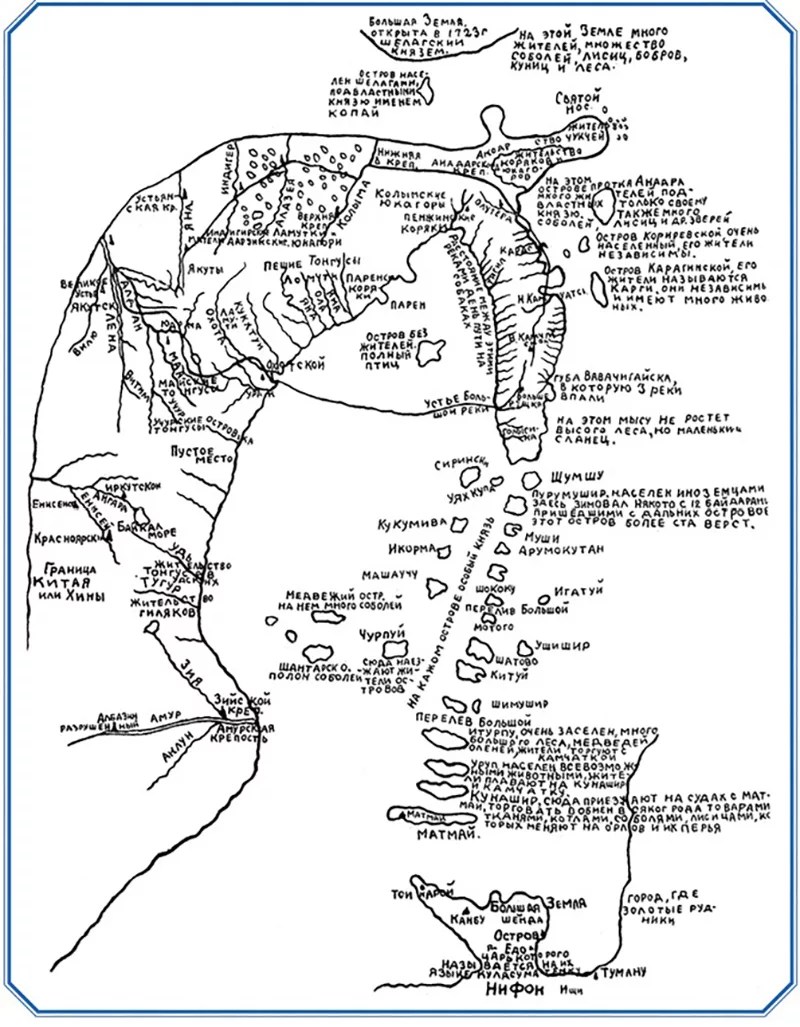
Otto Kotzebue, who heard from the Chukchi the story of Major Pavlutsky's skull, met representatives of this people half a century after the Russians abandoned Anadyr. In his notes The Rurik's captain admits to feeling uneasy when he and his crew disembarked and were met by a detachment of 50 men armed with daggers and sabers. The Chukchi spread skins on the ground, inviting Kotzebue and his sailors to sit in the middle, while they themselves settled around them.
"Their extremely unkempt clothing, dirty, savage faces, and long knives gave this group the appearance of a band of robbers; from their behavior, which gradually became bolder, I concluded that they frequently interact with the Russians. This people differs little in appearance from the Americans; their boats and weapons are the same; their spears, like those of the inhabitants of the American coast, are equipped with broad iron tips; they are similarly decorated with beads, which, however, are somewhat smaller among the Chukchi."
O. Kotzebue "Journey Around the World".
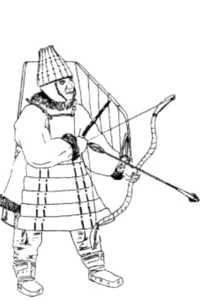
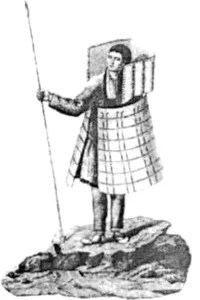


Every Chukchi man carried three knives: the longest, half a meter long, in a sheath on his belt; a second, slightly shorter, on his back, behind his left shoulder; and a third, "very small" (half a foot long), in his sleeve. The warriors' appearance matched their reputation. They fought fearlessly on land and undertook piratical voyages to the Americas. The Chukchi respected only two peoples—people they "were interested in fighting"—the Eskimos, fighters as fierce and resilient as themselves, and the Russians, who possessed modern weapons.
However, the Chukotka colonizers didn't have much in the way of firearms. Some Cossacks serving in those parts were armed with bows as early as the first half of the 19th century. Ethnographer Tan-Bogoraz cites an excerpt from the 1837 Cossack registry: "Stepan Kotelnikov—bow. Miron Popov—arquebus. Ivan Kupriyanov—bow," and so on.
Of course, cannons and rifles, even in small numbers, provided a strategic advantage, but the Russians often lacked the time to use them on the ground in local combat. Chukchi detachments appeared and disappeared faster than the gunners could swivel the cannon, roll a cannonball into the barrel, and light the fuse.
The rate of fire of local archers was significantly higher than that of the foreign musketeers. The main obstacle to the conquest of the peninsula, however, was the lack of any "decision-making centers" whose capture or destruction would have secured victory. It was precisely in this manner that small conquistador bands crushed the great kingdoms of Central and South America. And the "Siberian conquistadors" from Yermak's retinue annexed Western Siberia to the Tsardom of Muscovy, defeating the army of the Siberian Khan Kuchum in several battles and capturing his headquarters at Isker.
The Chukchi, however, lacked supreme rulers—power in the tundra was completely decentralized and the population was incredibly mobile—and boys were taught from childhood to race reindeer, a distance that could significantly exceed a marathon.
Naturally, the colonizers couldn't keep up with the natives. Although Siberian Cossacks were divided into foot and mounted, the latter didn't necessarily have horses, as they had to pay for their upkeep. Besides, horses were of no use in the swampy, roadless terrain. Reindeer were better!

Russian punitive detachments departed the Anadyr fortress on foot for multi-day marches, employing scorched-earth tactics. A detachment typically consisted of several dozen Cossacks and soldiers armed with rifles and several hundred native allies (Yukaghirs, Koryaks, Evens) armed with bladed weapons. They conducted offensive operations, raiding Chukchi camps, killing men, stealing reindeer, capturing women and children, and imposing yasak (tax) on those who submitted.
For 20 years (from 1727 to 1747) the colonial military campaign was led by Major Dmitry Pavlutsky.
Introducing this historical figure into the narrative, Peter Slovtsov in his Stories of Siberia expresses itself pompously: "Major D.I. Pavlutsky, for his role in restoring order in Kamchatka and for bestowing the peninsula's first pair of bulls and cows. He fell a victim to the bravery of the Chukchi, over whom he had previously triumphed."
The Pavlutskys were descended from Lithuanian nobles. Dmitry's great-grandfather entered the service of the Tsar of Moscow in Time of Troubles He was sent to Tobolsk, where he put down roots. It was likely also there that the future "victor of the Chukchi" was born. It is known for certain that he set out to conquer Chukotka from Tobolsk (more than 6 kilometers from Anadyr) with a large convoy, which included a pair of cattle—a bull and a cow. The animals reached their destination safely and multiplied, laying the foundation for dairy farming on the eastern fringes of the empire.
However, first, the "unpeaceful peoples" of this outlying region had to be sworn in and subjected to tribute. The Chukchi categorically refused to acknowledge themselves as subjects of the Russian Tsar or pay yasak. They had seen the consequences of this from the example of their neighbors, the Koryaks and Kamchadals who inhabited Kamchatka.
In his "History of Siberia," Slovtsov describes the "oppression" suffered by yasak-paying peoples at the hands of officials. Indigenous peoples ignorant of the laws of the Russian Empire were subjected to triple yasak instead of one, and their wives and children were taken hostage for petty debts or for "refusal to be baptized":
"The Kamchadals and other voiceless foreigners were driven to such extremes by intimidation that parents themselves sold their children to the Cossacks and industrialists for a ruble or a half-ruble... The government's suspicions also extended to the greed of Siberian clergy; they were forbidden to visit the newly baptized, and while this ban was lifted in 1735, they were also ordered to be watched so that they would not engage in trade under the guise of spiritual needs."
P. Slovtsov. "History of Siberia. From Yermak to Catherine II"
The Chukchi's reluctance to accept Russian citizenship is understandable. And Pavlutsky, as a military man, is also understandable. He was tasked with achieving a final resolution to the "Chukchi question" as quickly and effectively as possible.
Now it's called genocide, but in the 18th century, such words weren't known. Especially not in Chukotka.
Pavlutsky did not hesitate to use any means to intimidate or destroy a rebellious people. Once, during a smallpox epidemic in Anadyr, he ordered a captive Chukchi to be sent home to carry the epidemic to his own people. And so it happened: many of the Anadyr hostage's relatives died. Another time, the major ordered 200 Chukchi women, captured during yet another expedition, to be sent on foot to the very distant city of Yakutsk (2600 kilometers). All the women died on the way.
Major Pavlutsky made an indelible impression on his opponents and became a hero of the Chukotka talesTrue, his surname turned out to be too difficult for storytellers, so in legends he is referred to as "Chief" or "Yakunin."
"There was a Russian Chief, very cruel, who killed our people brutally. He held them by the legs and chopped them down with an axe, leaving their entrails spilling out. They tied men's penises to their necks and beat them on the back. The man would jump up and tear off his penis and cannonballs."
Chukchi folklore is generally distinguished by vivid physiological imagery. When recounting a battle, the narrator might say that there were many arrows in the air, "like drops of urine." The renowned Chukchi writer Yuri Rytkheu in his story Road Lexicon tells a story that allegedly happened in 1937, when Chukchi artists performed the "Dance of the Great Stalin" at a celebration in honor of the 20th anniversary of the October Revolution, based on the real myth of the Raven, who created the earthly world from his excrement:
"Stalin-Raven defecated and urinated copiously. From large chunks of his excrement, mountains and entire continents formed, and from his urine, seas, oceans, and rivers. The entire song-dance was illustrated by the movements of the famous dancer Atyk, who quite naturally depicted Stalin-Raven straining in creative tension, now squatting, now flying, and Gonom translated it roughly as: Great Stalin, our Leader and Teacher! He shit and pissed from on high, creating mountains, seas…"
Yu. Rytkheu. "Road Lexicon"
Incidentally, even under Stalin, the Chukchi freely sailed to America "on business," just as their ancestors had in the 18th century. It took the Russian and Soviet empires nearly three centuries to finally defeat this freedom-loving people and reduce their representatives to the status of anecdotal figures. This was only possible thanks to the exceptional cruelty of such "pioneers" as Dmitry Pavlutsky, who spared neither himself nor his enemies.
But one day retribution overtook the cruel leader, clad in an iron armor that protected him from arrows and spears.
"Yakunin's face is covered in iron, only two holes where his eyes should be," says one Chukchi folktale, describing the battle at the Orlova River, which ended with Pavlutsky's death. By that time (1747), the Chukchi were well aware of the pros and cons of firearms and had developed their own combat tactics: they would wait for the Russians to fire the first volley and then rush them to engage in hand-to-hand combat before the riflemen had time to reload.
“And there was no time to fill the guns anymore, because the Chukchi enemies went on spears, and they [the Cossacks] also went on spears against them, the Chukchi enemies, and fought with them for quite a long time...” – this is how one of the participants in the battle describes it in a report to the Irkutsk governor.
The Chukchi outnumbered the Russian detachment by approximately five to one. Once they deprived the Cossacks of the ability to fire their rifles, the outcome of the spear battle was a foregone conclusion. Soon, the Cossacks and Koryaks began to retreat, pressed by hundreds of Chukchi. Pavlutsky, clad in a metal breastplate, led the retreat. An eyewitness reports that the Chukchi were unable to kill Pavlutsky for a long time because of his breastplate. They shot at him with bows and spears for a long time, but still could not wound him. Finally, surrounding him like wolves around a deer, they entangled him with thongs, threw him to the ground, and found a place to stab him, just under his chin.
In the Chukchi legend, the description of Yakunin's death is more reminiscent of a duel between two heroic brothers saving their land from a terrible evil that came from the west.
"They (the warrior brothers) crept up to meet Yakunin. And one fired a horn arrow from a wooden bow and hit Yakunin in the right eye. The other fired a horn arrow from a wooden bow and hit Yakunin in the left eye. Yakunin staggered like a tree felled by an axe. Then the brothers rushed in, like wolves on a deer, seized him, and carried him far away. The Chukchi lit a large fire, stripped Yakunin of his iron clothing, and began to roast him over the fire. 'You've killed many people,' they said, 'let us roast you over the fire for a little while!'"
"So be it!" says Yakunin, "there's another Yakunin in the world! He'll come soon and take revenge on you a hundredfold!"
At this time, young Yakunin fled and climbed a high cliff, fending off the attacking warriors. He fought back for a long time with a large steel axe, but Uveurgin fired and hit him in the forehead with an arrow. The Chukchi grabbed him, carried him down, and brought him to the fire. They turned old Yakunin over the fire like a piece of meat: "Look, there's your other Yakunin! He came with you!" He looked and wept: "There's no other Yakunin now! No one will take revenge, no one will fight anymore! The battles are over!"
The storytellers turned out to be right. The battles soon died down. At least for the next 150 years, until the arrival of Soviet power in the tundra, the Chukchi were left undisturbed.
And they respectfully carried the skull of their enemy, with whom it was interesting to fight, on the tip of a spear as a kind of standard.