Things are getting tough: planes are being refueled.
Aircraft refueling is being restricted across Russia: jet fuel is becoming scarce due to the Ukrainian Armed Forces' strikes on oil refineries. How long will these restrictions last, and is it dangerous to fly?
Author: Tatyana Rybakova

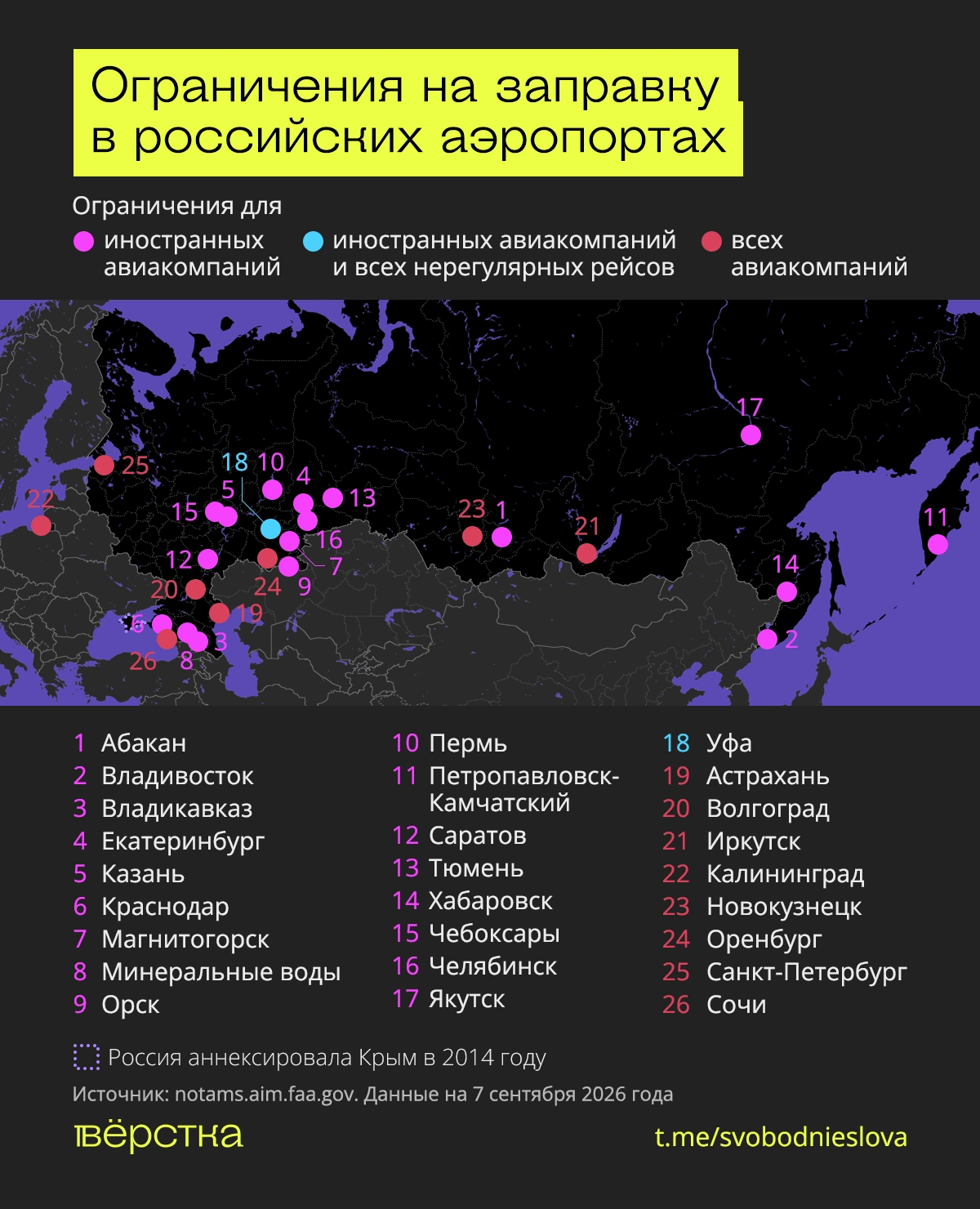
At Russian airports limited Aircraft refueling—fuel is allocated only for the flight, without regard to possible rerouting to another airfield or additional flight time. The restrictions so far primarily affect aircraft operated by foreign companies, but the geography is wide: from Kaliningrad to Kamchatka.
The first restrictions began in June, at the height of the first wave of the fuel crisis. They were imposed for periods ranging from one to seven months, but once the situation had somewhat normalized, they began to disappear. And in September, during the second wave of the fuel crisis, they reappeared: as of September 7, journalists counted 26 airports, in which such restrictions apply.
For example, from September 2, 2026, to March 16, 2027, refueling was introduced at St. Petersburg's Pulkovo Airport only in accordance with the flight plan for all flights, without any additional volumes. A similar notice was in effect from June 8 to December 6 of this year at Khrabrovo Airport in Kaliningrad. These measures apply to both Russian and international carriers. At 15 airports, the restrictions apply only to aircraft operated by foreign companies.
For example, in the Urals, there are currently four airports with such notifications: Koltsovo (Yekaterinburg), Balandino (Chelyabinsk), Roshchino (Tyumen), and Magnitogorsk Airport. Foreign airlines can refuel here, typically for only one flight.

At least seven airports in the Volga region have also imposed such restrictions: Kazan, Saratov, Cheboksary, Perm, Orsk, and Ufa (the latter also imposed restrictions on charter flights). In Orenburg, the restrictions apply to all airlines.
In Siberia, fuel restrictions for foreign airlines have been introduced in Abakan, while in Irkutsk and Novokuznetsk, restrictions apply to all flights. In the Far East, restrictions for foreign carriers have been introduced in Vladivostok, Khabarovsk, Petropavlovsk-Kamchatsky, and Yakutsk.
As usual, the situation is worst in southern Russia: of the six operating airports (the others are closed due to the war), refueling restrictions have been imposed on both domestic and international carriers at three airports—Sochi, Volgograd, and Astrakhan. Refuelling restrictions apply only to foreign companies in Krasnodar.

Than it threatens?
Refueling an aircraft "on the dot" dramatically increases the risks. A thunderstorm front may suddenly appear in the aircraft's path, forcing the pilots to decide: fly through it, risking the aircraft and the lives of passengers, or seek landing at a nearby airfield, as there may simply not be enough fuel to avoid the front. Situations involving the sudden formation of thunderstorm cells are not uncommon, and even more so on long-haul flights.
More fuel than calculated may be required in the event of a strong headwind, when the aircraft begins to ice up (this happens not only in northern latitudes), or other natural phenomena.

Fuel shortages can prevent an aircraft from making a second or third approach: this is a common occurrence when approaching airports with heavy traffic. Even more dangerous is the situation when, for example, pilots misjudged the landing (which can happen not only due to inexperience, but also at an unfamiliar airfield, in strong crosswinds, fog, icy runways, or other adverse weather conditions), or the aircraft's landing gear fails to deploy on the first attempt. In fact, any minor malfunction with limited fuel can turn into a serious incident.
If the restrictions continue until the frost sets in (and in northern latitudes, temperatures below zero at ground level drop as early as September), problems with the fuel itself may arise, as discussed below.
What happened?
Russia has always been self-sufficient in jet fuel and even exported a small amount of surplus. Russia uses two grades of jet fuel: TS-1 and RT. The former (aircraft fuel-1) is the most widely used: it powers all civil subsonic aircraft in Russia and the CIS, as well as all helicopters. RT (rocket fuel), as the name suggests, is of higher quality and is used in military aviation, particularly supersonic and high-altitude aircraft, and in rocket engines. However, in civil aviation, it is also used to fuel aircraft on long-haul flights and in the Far North (including international flights along the polar route).

Refining jet fuel yields only a small amount—approximately 4–4,5%. For comparison, the yield of diesel fuel is 30–35%, and that of motor gasoline is about 15%. This is due to the rather strict requirements for jet fuel and, consequently, more meticulous production procedures—from hydrotreating (removing undesirable sulfur and unstable compounds to prevent corrosion of engine components) to the addition of strictly defined additives that reduce engine wear, prevent fuel oxidation, the occurrence of static electricity, fuel crystallization at low temperatures at high altitudes, and a strict fuel ignition temperature limit. In total, with an annual primary oil refining volume of 270–285 million tons in Russia was produced 11,4–11,5 million tons of jet fuel. Of this, approximately 10 million tons were used within Russia annually, and the rest was exported.
The first blow to aviation fuel was the drone attack on Moscow RefineryAs a result, it still operates at 10% capacity: the Moscow Oil Refinery supplied jet fuel to the entire Moscow air hub, the largest in the country. The plant produced 1,4 million tons of jet fuel per year, meaning a volume equal to its exports immediately dropped. Then came the attacks on the largest refineries, which also produced significant volumes of jet fuel.

So, Omsk Oil Refinery, the largest in Russia, historically supplied the lion's share of jet fuel needs for Siberia, the Urals, and parts of the Far East. It was attacked in July, causing localized damage. The damage was quickly dealt with and is now operating at increased capacity, compensating for fuel shortages in the European part of the country.
Ryazan Refinery — one of the main suppliers of jet fuel for the Central Federal District and the Moscow aviation hub. Following the massive May attack, the plant was being restored, but a new strike on September 6th again damaged the isomerization unit, forcing the plant to partially suspend production. Fuel production has been severely limited.
Kstovsky Oil Refinery (NORSI) produces significant volumes of jet fuel for the Volga and Central regions. According to management (the refinery is owned by Lukoil), production was restored in August and September and the plant is operating at full capacity. However, given the recent attack on the Ryazan Refinery, further attacks cannot be ruled out.
Yaroslavl Oil Refinery — a key producer for the Northwestern and Central Federal Districts. It has been subject to regular attacks since the beginning of the year, the most recent one occurring at the end of June.
Volgograd Oil Refinery It is a key producer for the Southern Federal District, supplying aviation fuel not only to civilian airports in the south of the country and the North Caucasus region, but also to military airfields. Production has been restored, but its proximity to the theater of military operations poses a risk. Furthermore, as a fuel producer for military aircraft (the very same Republic of Tatarstan), the plant primarily serves them.
What measures are being taken?
Back in June, the government completely banned exports jet fuel until the end of November, while sharply increasing import of jet fuelAbout 140,000 tons of jet fuel were quickly imported from Belarus, and there's an agreement to import jet fuel from India. But the country's aircraft fleet consumes over 10 million tons per year, or about 800,000–850,000 tons per month! If expert estimates are correct, and oil refining volumes have fallen by 20%, and the decline in jet fuel production is taken as a similar figure, then Belarusian fuel will clearly not be enough to cover the deficit. And given that fuel exchange trading volumes already reached 10% in June and July, fell by 40%, then Indian imports may not be enough. Moreover, let's not forget that war requires ever more fuel, including jet fuel. Considering that Russia is currently stockpiling reserves for massive attacks on Ukraine during the autumn and winter, it's not surprising that the authorities lowered fuel standardsNow it only needs to stay warm at minus 50 degrees Celsius, instead of minus 60 degrees Celsius. This means that long-distance flights will soon become problematic, and in the North, completely impossible—that's where the RT brand, currently used to fuel missiles and military aircraft, is used: there, in winter, temperatures at altitude drop below 50 degrees Celsius.
However, other routes won't be any easier: at the same time, the authorities are allowing small refineries to produce jet fuel. Such refineries are typically limited to the primary stage—straight-run crude refining. Subsequently, they will likely compensate for the low quality with additives. What are the risks for aircraft engines? First and foremost, accelerated wear—and aircraft engine production in Russia is still a problem. But it also disrupts the fuel's ignition temperature—which poses a serious risk of accidents.
Perhaps the authorities believe that with winter approaching, the Ukrainian Armed Forces will switch to energy facilities and cover the fuel deficit outside the peak season. Zelenskyy has repeatedly stated that in the event of such Russian strikes, Ukraine will respond in kind. In any case, the Ukrainian Armed Forces have now focused their attacks on military facilities: airfields, launch pads, and so on, apparently seeking to minimize the Russian army's striking power. However, attacks on oil refineries have not ceased completely, as exemplified by the recent raid on the Omsk Oil Refinery.
However, the Ministry of Energy and the Ministry of Transport have been working all summer statedThat the deficit is not critical and the shortfall is covered by imports and accumulated reserves. Reassuring statements were of no help—even the end of the peak holiday season hasn't led to the lifting of restrictions.
Than it is fraught?
The increased risks to flights have been discussed above. However, the shortage of jet fuel is already affecting airfare prices. affects in the most direct way: after all, fuel accounts for 30-40% of the cost of each passenger flight. On average, Russian air carriers' costs have increased by 7-17%, and at the peak of the season, tickets went up by 10–50% depending on the region: in the southern regions, prices have expectedly risen more.
Refueling restrictions, especially for foreign companies, will give them an incentive to reduce or even completely stop flights to Russia. After Ukrainian President Volodymyr Zelenskyy warned that Russian skies are unsafe for flights, some countries have already begun curtail air travel To Russia. Air Tanzania completely suspended flights to Russia on September 4, low-cost carrier Air Arabia canceled a large number of flights planned until the end of the year, and Flydubai, a popular airline among Russians, reduced its route network. The even more popular Turkish low-cost carrier Pegasus canceled more than a dozen flights to Moscow the night after Zelenskyy's announcement, officially citing "technical reasons." The schedule was later restored, but flight stability has declined, in part because Moscow airports have recently been regularly closing their skies due to drone threats. Air India has significantly reduced its flight schedule to Russia, and Kazakhstani airline Vietjet Qazaqstan has cancelled flights from Astana to Omsk.
Obviously, without the ability to refuel in reserve at Russian airports, many airlines simply won't risk it during the fall and winter season, when passenger numbers are lower (and therefore profits are lower) and adverse weather conditions are more prevalent. Furthermore, it's worth protecting their aircraft engines from low-quality jet fuel.

Fewer foreign airlines mean higher prices for Russian carriers and a poorer route network. Russian pilots aren't suicidal, so why take risks where the risk isn't justified, including financially? Consequently, unprofitable regional flights will be the first to suffer. The problems that could arise in the North with the onset of frost have already been discussed—meanwhile, even northern supplies are currently in doubt due to fuel shortages, so this winter, northern regions could face both shortages and the inability to quickly transport sick passengers to the mainland.
__________
Of course, the problems of air carriers are not as noticeable as the kilometer-long queues of cars at gas stations in St. PetersburgBut while the problems of motorists are more related to inconvenience, the problems with jet fuel are, without exaggeration, a matter not only of passenger comfort but also of life and death. However, judging by the Olympian calm of the relevant agencies, the Russian authorities treat the lives of passengers in much the same way as they treat the lives of those sent to the front.