
Concrete coating
The history of Vologda's urban conservation renaissance, which ended with the arrival of a Stalinist governor

In 2019, a scandal erupted in Vologda: authorities decided to encase the city's embankment in concrete, and hundreds of residents rose to defend the green riverbanks. While the river failed to be saved from being concreted, the movement's defense gave birth to the "Urban Environment Laboratory." For several years, it helped design new spaces, engaging residents in the process. These progressive trends didn't last long. After Georgy Filimonov (the same man whose office houses six portraits of Stalin) took office as regional governor, the city was left without a chief architect, and the "Urban Environment Laboratory" was disbanded. However, monuments and sites began appearing in Vologda that are, at best, perplexing. "NeMoskva," together with the media outlet "V Lesakh," tells the story of Vologda's short-lived urban conservation heyday.
Georgy Filimonov was born in 1980 in Tomsk. In 1981, his family moved to Cherepovets in the Vologda Oblast. He graduated from the Faculty of Humanities and Social Sciences at RUDN University with a degree in international relations. He wrote his dissertation on US foreign cultural policy as a component of soft power. He worked in the Executive Office of the President of the Russian Federation, first as a consultant, then as a foreign policy advisor, and then as a domestic policy adviser. In November 2021, he was appointed Deputy Chairman of the Moscow Oblast Government, where he oversaw agriculture, food, and forestry. In October 2023, he was appointed Acting Governor of the Vologda Oblast. In September 2024, he was elected head of the region.
Over the course of a year, the new governor of the Vologda region has managed to make some big statements and make headlines. First, after ordered to erect a monument to Stalin in the city - and erected one. Then - when объявил about the start of the anti-alcohol campaign: starting in the spring of 2025, alcohol in the region can only be purchased from 12:00 to 14:00, thus Filimonov plans to to achieve the same effect as in Chechnya, where they drink little and have a lot of children. "We need to learn from Ramzan Akhmatych first and foremost. These are best practices, how many times do I have to tell you?" claimed He is at a meeting on the anti-alcohol campaign.
Filimonov also admires his great-grandfather, a Chekist, who carried out deportation of Chechens and Ingush in 1944. A KGB colonel, he served throughout the Great Patriotic War stayed in the Caucasus and received four Orders of the Red Banner, two of which were for the deportation and for fighting "counterrevolutionary elements" in the rear. Filimonov is proud of his great-grandfather: "It was an era of titans. We, their descendants, have no right to weakness," is how he concludes his next post about the "KGB" ancestor.
There is a picture hanging in Filimonov's office six portraits of Stalin (in one of them the General Secretary is shaking the hand of the Vologda governor), as well as portraits Beria, Mao, the tsarist generals Skobelev and Ermolov, many icons and a reworked poster The series "The Word of a Boy" with Filimonov's face. He himself, like Stalin and Mao, wears a military jacket. About his political views says, which represents “the patriotic wing, which can be called dynamic conservatism in United Russia” (however, he joined the party only before the elections).

Over the past year, Filimonov has fired dozens of employees at all levels under the pretext of reorganization and increased efficiency, only three of whom managed to occupy the chair of the Minister of Health.
At the beginning of 2024, the head of the Committee for the Protection of Monuments, Elena Kukushkina, left her post. Local media reported that she "left"Neither Kukushkina herself nor the authorities have any reasons did not call, however, one of our interlocutors claims that the official "hindered business development." In October, near Vologda not gone chief architect - this problematic and the optional position in the city administration was simply abolished.
All this has greatly simplified any urban planning approvals. Those who disapprove of the governor's actions are afraid to speak out. As Anna Makarova, a Vologda-based restoration architect, explains in an interview with NeMoskva. (requested anonymity, name changed) Now talking about preserving monuments is like spitting in the wind.
However, it was not always so.
Renaissance amidst rebellion
The renaissance in urban conservation, interrupted by Filimonov's arrival, began in Vologda in 2019. As often happens, it began with a scandal: the authorities decided to encase the city's grass-covered embankment in concrete.
"Forty years ago, Muscovites would come to the site where Vologda was founded, look at the river, and say, 'A living river flows through the city,'" explains Alexander Sazonov, a tour guide with nearly half a century of experience, in an interview with NeMoskva. "But no, Vologda needs to be, if not like St. Petersburg, then like Yaroslavl..."
Townspeople learned The embankment was only about being concreted when they started cutting down trees. Nadezhda Snegireva, an architect originally from Vologda, spoke at one of Putin's meetings with architects and developers. asked The president asked why such important decisions are made without consulting city residents. Her speech became a catalyst, and a campaign to protect the embankment began in Vologda: rallies, collection signatures, eco-quests, workshopsA project was created specifically to coordinate discussions. "The river unites", where entered representatives of local urban conservation communities and the regional branch of the Union of Architects of Russia.


The embankment couldn't be saved at the time—the construction process had already begun. But the campaign was so widespread that city authorities couldn't ignore it. Then-Mayor Sergei Voropanov invited Snegireva to become his advisor on urban development and to create a mediating structure between the city and the authorities. This is how the "Urban Environment Laboratory"—an autonomous non-profit organization within the Vologda administration—was born. The organization helped the authorities create new spaces using participatory design method.
"We developed the projects in collaboration with city residents and relevant experts, based on research and discussion," says Victoria Grebelkina, one of the Lab's employees. "We studied how the space functions today, what meanings it conveys, what invisible stories and personal histories it holds, and identified its values and challenges. And, of course, we collected residents' requests, held a series of discussions, and then refined the projects. The concept for the future space was built on all of this. It was an open process in which every interested resident could participate."
Over the course of its work, the laboratory has developed approximately 20 public space projects for Vologda, some of which have already been implemented and are now taking on a life of their own. For example, the skate park was designed in collaboration with the skateboarding community, and they now maintain it themselves. Improvement projects Zatonovsky coast и Pirogov Boulevard, prepared by the Laboratory, were included in the federal register of best practices of the Ministry of Construction.

But the Lab's main goal, according to Grebelkina, was not the creation of "comfortable and cool" public spaces (which Victoria calls a "pleasant side bonus"), but the development of civic participation:
"[We wanted] to demonstrate every resident's right to their own city and give them the opportunity to influence the decisions made there. Which, in fact, ultimately proved our undoing."
"Pesnyary" without the Vologda resident
With Filimonov's arrival, according to Victoria, the city was bombarded with "a huge amount of money that needed to be spent before the elections." The acting governor, our sources claim, demanded swift action from the entire administration, and there was no time for the public discussions previously conducted by the Laboratory. Projects were now approved personally by Filimonov, his appointed mayor, Andrei Nakroshaev, and no one else.
"For us, the end user is always our priority. And that's not just one person saying, 'Well, let's do it this way,' and that's how it should be. That's not our approach," says Victoria.
In the summer, the city administration dismissed the head of the Laboratory, Tatyana Zhdanova, and in her place appointed Svetlana Kudryavtseva, who previously headed a department in the Department of Urban Development and had no interaction with the Laboratory. Then, all the other employees filed their resignation letters on the same day. firing"We spent four years of our lives trying to do things completely differently," Grebelkin said of the dismissal.
The laboratory has changed its name (it is now called "Development of urban spaces"), hired new employees and is preparing projects commissioned by the governor.
Projects implemented without public discussions are controversial. At Babushkina Square, where the train and bus stations are located, plan The Urban Environment Laboratory was supposed to feature a green park surrounded by modern bus stops, with two parking areas at the edge. According to surveys, residents' primary desire was to preserve the trees and increase greenery. But the governor approved a different project. in the end The old, tall trees were cut down, young saplings were planted, the area was paved with cobblestones, a "City of Labor Glory" stele was installed, and benches and bike racks were placed around the perimeter. The result was a deserted park with an area of 11 thousand square meters.

One of the bus stops was sacrificed to create the square. stopsResidents were unhappy: it took five minutes to walk from the train to the bus stop. To restore the stop, the pedestrian crossing was removed. And a month after its opening, the paving in the new park began to peel. Filimonov had to Look for someone to blame: "The contractor will be held fully responsible. This is disastrous. I told him to lay asphalt, not paving stones."
Filimonov's frenetic activity takes place under знаmenем development of territories and increasing the region's tourism potential. One of his latest initiatives is a series of monuments designed to celebrate local brands—butter, lace, and the famous Pesnyary song about a carved palisade, the city's unofficial anthem. Five musicians They stand on the embankment in the very center, and then the tourist is met by a series of sculptures, which depict the heroes of the composition: a dark-eyed girl, a young postman, and finally, their cheerful wedding.

Valery Malinovsky, a Vologda-based architect, designer, and entrepreneur, works with hotels and museums, creating merchandise and souvenirs. He's not exactly thrilled with the new sculptures:
"I looked at the dark-eyed woman's outfit. I thought something was wrong, not Vologda-style. So, I went to the narodniks [folk culture experts]. "What does it smell like?" I asked. "It smells like Kuban and Cossacks," they answered, "but not at all like the Russian north."
"There she has a fitted dress, we didn't wear that here. Okay, the artist decided to depict Vologda lace. But why is it running along the hem? Do you know how much it costs? No girl would sew it onto her hem," Malinovsky is perplexed. "Then there's that wedding, the bride's braid is hanging loose. The Narodniks saw it and burst out laughing: 'What a whore!' Because we didn't wear braids hanging loose, either before or after marriage. She's seducing him. And the groom is actually Ukrainian—he's wearing an embroidered shirt, not a kosovorotka. He has a satin belt and is tied to the left—and we always have a knife hanging on the left side! A Vologda man never goes anywhere without a knife. All the men here have noticed."
Malinovsky is even more annoyed because monument to the "Pesnyary" groupThe song about Vologda appeared in the "Belarusian Beatles" repertoire after Vladimir Nikolaev, a native of Vologda, suggested performing it as a song by one of the members of the large group (almost 60 people were part of it). The sculpture depicts the five musicians who performed "Carved Palisade" during the program "Pesnya-76. Final," which won the competition for Pesnyary. But there were six of them at that concert, and the sixth one, whom the sculptor chose to omit, was Nikolaev!
"And why the hell do we need Pesnyary without a Vologda native?" Malinovsky asks rhetorically.
"A horror incompatible with a museum exhibition"
Another of Filimonov's projects is the so-called forest parks, which he plans to establish in the summer of 2024 ahead of the gubernatorial elections. The governor's idea for such parks spied в Moscow Region, where he himself used to work.
In the Vologda district, a park was created on the outskirts of the city. A small area with benches was created right under one of the major highways, with a path leading off into the forest. have established gazebos, barbecues, and animal sculptures—for example, a bear with a balalaika. The entrance hall bears the inscription: "Vologda region—a place of power in the Russian world." Filimonov first mentioned these words. uttered In December 2023, at the "Russia" exhibition at VDNKh, they are now the region's slogan.


The land on which the park was created in the shortest possible time before the elections belongs to the Semyonkovo State Museum of Wooden Architecture. It is one of the museums where crumbling wooden huts and churches from villages were brought in the 1980s, like Kizhi in Karelia and Vitoslavlitsy in Novgorod. Some of the buildings are three hundred years old.
Between the "park in the forest" and the museum is a thin copse and a fence, but legally, the land beyond the fence is also museum property. In October, Valery Malinovsky sent a request to the Ministry of Emergency Situations to clarify whether the placement of barbecues near wooden monuments posed a fire hazard. As a result, the agency issued a fine and a warning... to the museum!

The proximity to the park proved a burden for the institution. "Semenkovo" is more than just village houses. The museum staff collects folklore, performs it, researches the region's history, and is skilled in restoration. Many of them have spent their entire lives at the museum. Tours here are costumed performances based on true stories of Vologda peasants, which the Semenkovo staff finds in the archives.
No accordion can drown out the loudspeaker. The noise, music, and barbecues ruin the atmosphere of the reconstructed village.
"The museum is a kind of time machine. The creators wanted visitors, upon entering the museum, to be transported back a hundred or two hundred years and be fully immersed in that context," explains Valery Malinovsky.
In recent months, he's been regularly submitting inquiries and appeals to various authorities regarding Semyonkovo, trying to find out who's building it, on what grounds, and whether the land was actually taken from the museum. His requests are being tossed around.
"I have a general letter—to the government, the prosecutor's office, security, and the Department of Economic Development. The government passed me on to the Department of Internal Policy, who passed me on to the Department of Forestry. And some specialist in the forestry department replied that parks in the forest—" Well, this is beautiful! — says Malinovsky.
He has not yet been able to obtain an answer to the question of who erected the gazebos and sculptures.

Malinovsky became a champion of Semyonkovo out of an old love for the museum: in the 80s, when it was still under construction, Valery worked there, was part of one of the first teams, earned his degree as a restorer, and even held his own wedding there. Furthermore, after several high-profile publications, staff members were banned from speaking out about the events or communicating with journalists, and Malinovsky took on all publicity work himself.
The staff remained silent until the incident on Pokrov.
On October 14th, there was a big performance at the museum. Just beyond the fence, another party was going on: people were barbecuing, drinking, and music was blasting from the speakers. At the height of the festivities, several drunken young people became curious about what was going on in the museum and decided to crawl under the fence to check out the neighbors' situation. Afterward, Semyonkovo's director, Natalia Kirshina, wrote a long and emotional letter. post on VKontakte.
"I'm tired of remaining silent. Talking to officials is fruitless. We're being urged to seek compromises, to take a quiet, wait-and-see approach, to accept what's happening. When I see bears with balalaikas installed right next to the museum, drunken, dysfunctional youths crawling under the fence, and autumn stripping the last leaves from the trees, revealing a horror incompatible with a museum exhibit, it feels like years of work and the team's creative drive have been wasted. And this happened in the summer of 2024," the text reads.
The post received 3,5 likes and hundreds of supportive comments. After its publication, according to Malinovsky, the authorities began discussing the situation with museum staff for the first time, offering to take over the gazebos and barbecues, whose status is unclear.
The museum doesn't want it yet, and the barbecues are left unattended.
Assassination attempt on Ferapontovo
Another famous Vologda location, the Ferapontov Monastery, the only UNESCO World Heritage site in the Vologda region, is also under threat of losing its unique environment and atmosphere. Inside, 15th-century frescoes by DionysiusThe paintings can be viewed strictly in small group sessions, like Leonardo's "The Last Supper."
The view of the monastery from the highway is breathtaking: picturesque meadows, two lakes, an ancient village, and between them, the monastery buildings. In the summer, you're almost sure to encounter artists with their easels here. They took a liking to Ferapontovo back in the Soviet years: they came in groups to paint plein air, brought students, and rented apartments for the summer in this far from resort-like place. 30 artists even bought surroundings old houses and founded a kind of colony.
According to Vologda architect and restorer Anna Makarova, the environment around the monastery has remained untouched since the late 17th century.


In the spring, an alarming rumor circulated: the land around the Ferapontov Monastery would be given over to development.
On the site of public procurement a contract appeared To develop a new design for the protected areas, which previously included the meadows beyond the monastery walls. Before they could be redesigned, a drawing of a future cottage village was added to the cadastral map of Russia. If it is built, Ferapontovo will lose its prestigious UNESCO World Heritage status: the organization only grants this status to sites preserved in their historical environment.
For Filimonov, Ferapontovo is a special place. He calls it "home," and he even voted at a polling station here during his own election. According to local bloggers, built an estate with a view of the lake, where he allegedly moved his parents.
"How he managed to get this plot of land, I don't know. And he built the house on three levels—even though it's a protected area, there are height restrictions. And he even cut down everything that was growing there," Anna Makarova claims.


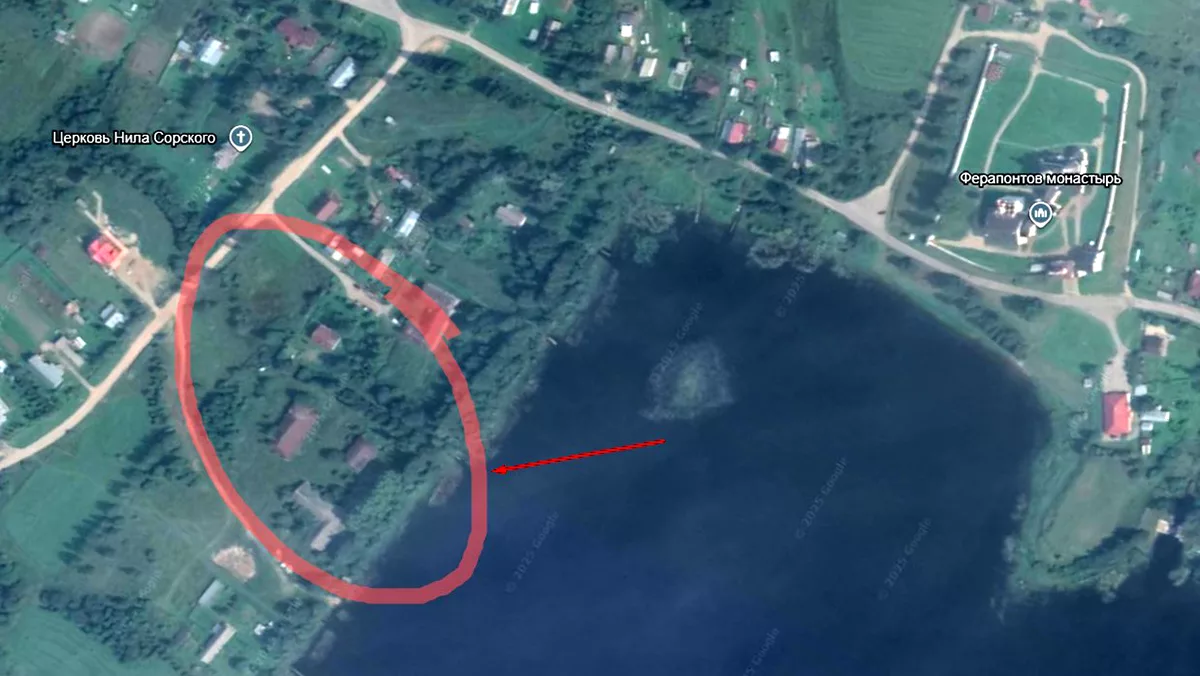
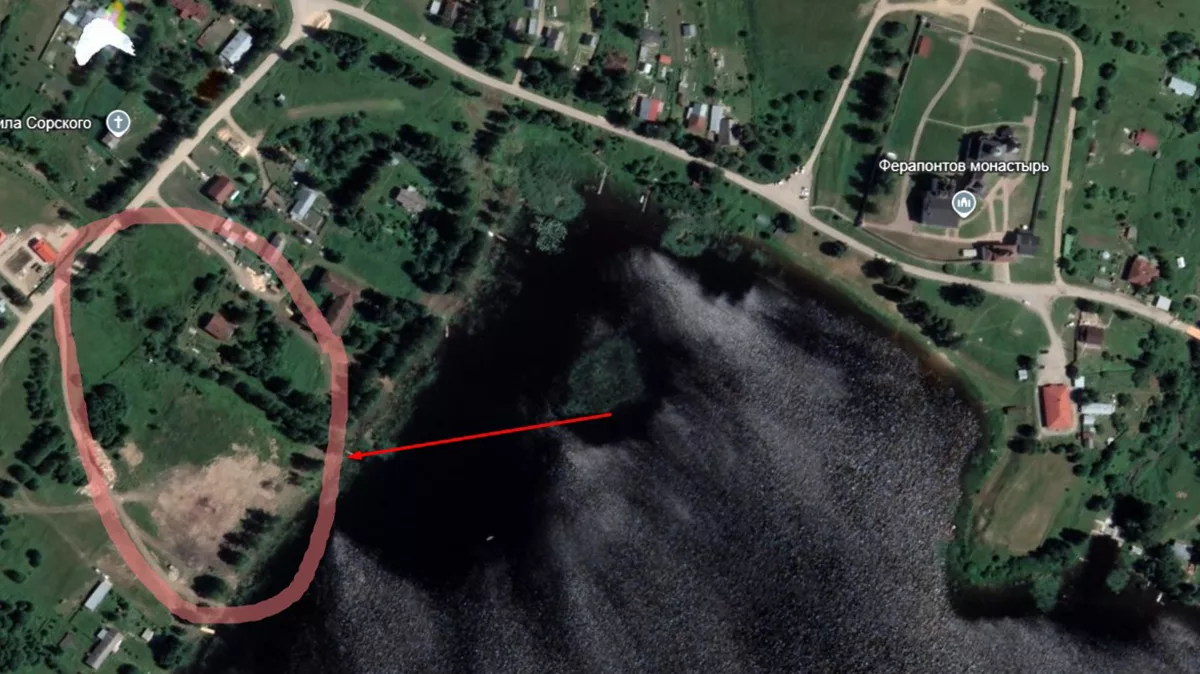
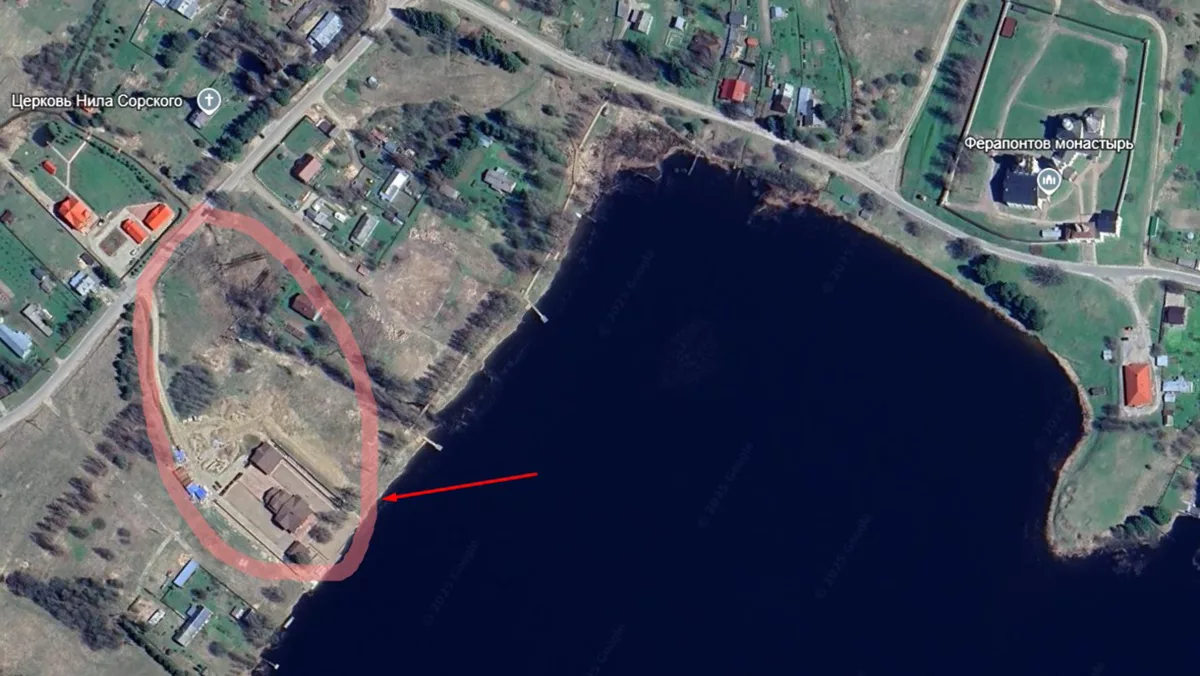
Historical satellite images of the site where Filimonov's estate is presumed to be located (the geotag was provided by an independent Vologda journalist who asked not to be identified). 2018, 2021, and 2024, respectively. Source: Google Earth.
The formal reason for revising the monastery's protected zones was the preparation of a new master plan for the Kirillovsky District. The technical specifications, drawn up in April 2024, called for the construction of campsites, glamping sites, and sports centers near the monastery. In June, when rumors of development around Ferapontov began to circulate, Filimonov issued an official statement. statement: allegedly, no major construction is planned in the protected zones. At the end of October, the contract for the zone review was terminated "based on a decision to unilaterally terminate the contract."
However, the status of these lands still allows for non-permanent construction, which includes anything without a poured concrete foundation. Frame and modular houses, bathhouses and saunas, gazebos, garages, stores, hangars, and other light- to medium-weight structures can be built on a pile foundation.
Currently, the meadows around the monastery have been carved into small plots. According to Rosreestr data, these plots were registered as property in August 2024.
Plots of land in the fields near the monastery. Screenshot of a public cadastral map. Source: page of Vologda activist and writer Vadim Demenyev on VKontakte

Throughout 2023, Victoria Grebelkina and the Urban Environment Laboratory worked on a new embankment project—the very one that sparked the organization's existence. Both experts and residents were keen to green the concrete banks, make them habitable again, and return the river to its residents. Fifty-four experts and over 500 residents met for nearly a year, conducting research, workshops, and discussions, jointly testing solutions, and formulating a development program for the embankment. In December 2023, the final project was completed. submitted to the public.
“We realized that we needed to delve deeper into issues related to identity and the image of Vologda, so that the embankment spaces would be a reflection of this city,” she said. presentations Architect Kamilla Ibragimova.

But Filimonov is unlikely to return to this project, our sources believe.
"Unfortunately, I think the tradition of concrete encasing will continue," concludes Alexander Sozonov.
"I think the new administration wants to make the regional capital a truly metropolitan city. And our Vologda is beautiful in its compactness, its cozy atmosphere, its low-rise buildings, and its greenery," says Grebelkina. "If you take a small green river and line its banks with granite, you still won't get the Moskva River. It will simply be a parody of a capital. And in doing so, the city's image will certainly be lost."
When the lab staff resigned, they wrote a post in their group explaining their reasons for leaving (now deleted). It was shared thousands of times, with eight hundred comments.
"You know, usually good comments are rare. Only the disgruntled ones do," says Victoria. "And then, finally, we saw those who had been supporting us all this time. They showed up. And we thought: 'Oh my God, people, where have you been all these four years?'"